 EN
EN
How AEM Electrolyzer Technology Works and Why It Stands Out
Core Mechanism: Anion Exchange Membrane Water Electrolysis (AEMWE)
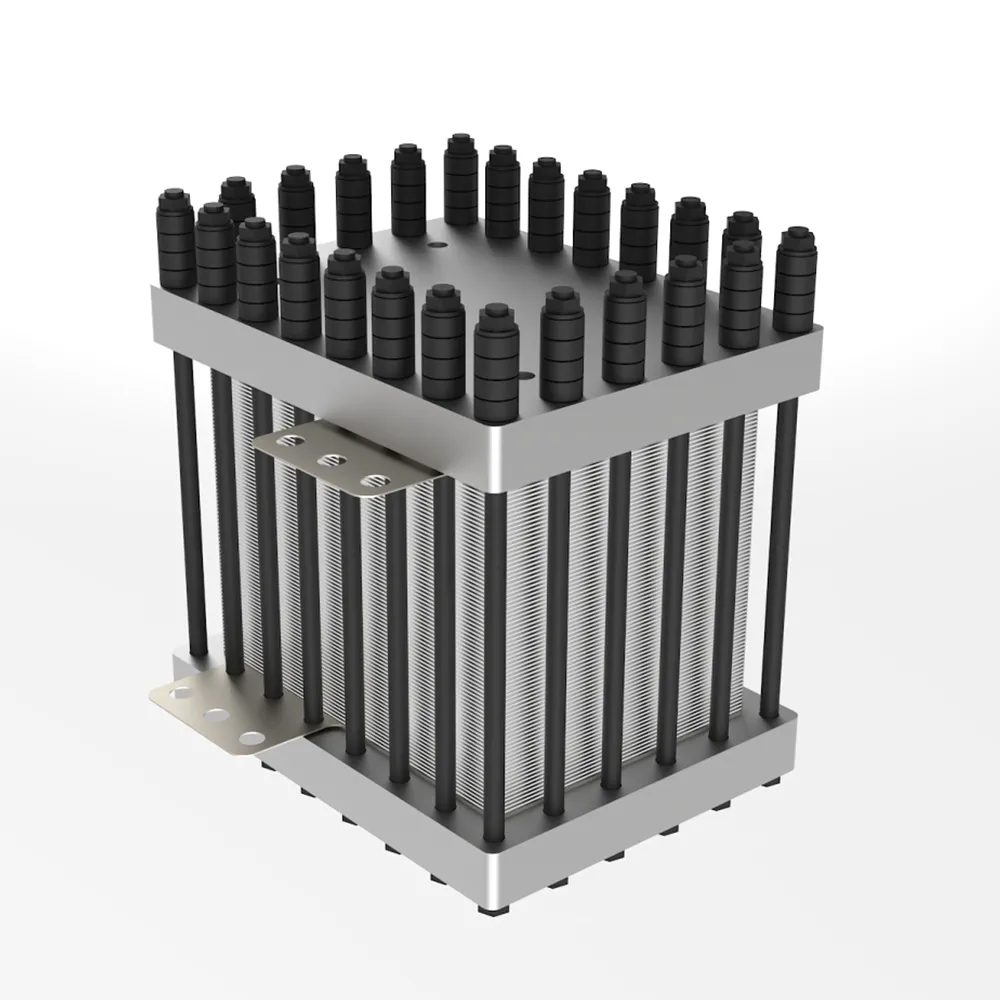
An AEM electrolyzer splits water into hydrogen and oxygen using a solid anion exchange membrane that conducts hydroxide ions (OH⁻) from the cathode to the anode. Operating in a mildly alkaline environment, it reduces corrosion risks and enhances safety compared to traditional liquid alkaline systems. The compact membrane structure minimizes gas crossover, enabling direct production of high-purity hydrogen at the cathode. Unlike proton exchange membrane (PEM) systems, AEM avoids acid-resistant materials and expensive perfluorinated membranes—simplifying stack construction and improving long-term robustness. This architecture also supports rapid load-following, allowing seamless integration with fluctuating renewable power without compromising efficiency.
Strategic Advantages: Non-Precious Catalysts, Low-Cost Materials, and Rapid Dynamic Response
AEM’s most compelling advantage is its material strategy: nickel- and iron-based catalysts replace platinum and iridium, cutting catalyst costs by ~85% versus PEM. Paired with lower-cost membranes and stack components, total capital expenditure can fall up to 40% below conventional alkaline systems. Despite this cost reduction, demonstrated system efficiency remains strong—75–80% under variable loads. The membrane-enabled dynamic response allows AEM units to track second-by-second changes in solar or wind output, supporting modular, mobile, and grid-responsive deployment. Recent advances in catalyst coatings and membrane durability have extended operational lifetimes beyond 10,000 hours in lab-scale testing—bringing commercial viability within reach.
AEM vs. Competing Electrolyzer Technologies: Efficiency, Cost, and Scalability
Performance Comparison with Alkaline, PEM, and SOEC Systems
Anion exchange membrane (AEM) electrolyzers occupy a distinct middle ground among mainstream technologies. PEM delivers high efficiency and fast response but depends on scarce platinum-group metals—driving up costs and contributing to annual degradation rates of 2–4% at scale. Alkaline systems are mature and low-cost but suffer from low current density and poor load flexibility, limiting their compatibility with intermittent renewables. Solid oxide electrolysis cells (SOEC) achieve superior efficiency at 700–850°C but face thermal cycling stress and high-temperature corrosion, shortening service life. AEM bridges these gaps: it uses abundant nickel and iron catalysts, matches PEM’s compact footprint, and tolerates lower-purity water—though its current energy conversion efficiency trails PEM and SOEC. These tradeoffs position AEM as a pragmatic choice where cost, scalability, and material availability outweigh peak-efficiency requirements.
Total Cost Reduction Potential: Stack Design, Catalyst Savings, and LCOH Impact
AEM lowers capital expenditure through two primary levers. First, eliminating precious metal catalysts reduces material costs by up to 70% relative to PEM stacks. Second, simplified stack design—requiring no titanium bipolar plates or specialized coatings—enables standardized, high-volume manufacturing. Together, these advantages support a projected levelized cost of hydrogen (LCOH) below $2.00/kg by 2030, with stack costs potentially falling to $300/kW. Modular cell architecture also accelerates economies of scale—reaching full production readiness 40% faster than alkaline systems—enabling smooth scaling from 1 MW pilots to gigawatt facilities without redesign. When combined with reduced water purification demands and improved membrane longevity, AEM’s total cost of ownership undercuts both PEM and alkaline electrolyzers in applications prioritizing upfront affordability and operational simplicity.
Commercial Readiness and Scalable Deployment of AEM Electrolyzers
AEM electrolyzers are transitioning from laboratory validation to commercial deployment, supported by modular architecture and low-cost materials. Manufacturers now offer scalable stack configurations—from 1 MW pilot plants to multi-megawatt industrial installations—allowing producers to align capacity precisely with demand and avoid oversized capital commitments. This modularity enables incremental expansion: new units can be added as green hydrogen markets mature. Early deployments in Europe and Asia report operational uptime exceeding 95%, confirming AEM’s ability to meet industrial reliability standards for continuous production. Its rapid dynamic response further strengthens compatibility with renewable generation—a critical enabler for building a scalable, emissions-free hydrogen supply chain.
Enabling Green Hydrogen at Scale: AEM’s Role in Renewable Energy Integration
Modularity, Load-Flexibility, and Grid-Responsive Operation for Intermittent Renewables
AEM electrolyzers are uniquely suited to harness intermittent renewable energy. Their modular design allows operators to ramp hydrogen production up or down in minutes—precisely matching the variable output of solar and wind farms. This load-following capability converts surplus electricity during peak generation into storable hydrogen, preventing curtailment and turning intermittency into a strategic asset. Unlike rigid systems requiring steady power input, AEM stacks respond rapidly to grid signals and tolerate frequent start-stop cycles without performance loss—supporting active grid balancing and ancillary services. By combining scalable deployment with real-time responsiveness, AEM transforms green hydrogen from a niche energy carrier into a foundational element of a flexible, resilient, and fully decarbonized energy system.
FAQ
What is an AEM electrolyzer?
An AEM electrolyzer is a device that splits water into hydrogen and oxygen using an anion exchange membrane, which conducts hydroxide ions. It operates in a mildly alkaline environment, enhancing safety and reducing corrosion risks compared to traditional systems.
How does AEM compare to PEM and alkaline electrolyzers?
AEM electrolyzers bridge the gap between PEM and alkaline technologies by balancing cost, scalability, and efficiency. They use non-precious metals, require less expensive materials, and offer strong load flexibility, making them compatible with renewable energy sources.
What are the cost benefits of AEM electrolyzers?
AEM electrolyzers reduce costs by using non-precious metal catalysts like nickel and iron, simplifying their stack design, and enabling standardized, high-volume manufacturing. These factors collectively lower the levelized cost of hydrogen (LCOH) below $2.00/kg by 2030.
What makes AEM suitable for renewable energy applications?
AEM electrolyzers are highly modular and have excellent load-following capabilities, making them ideal for intermittent renewable energy sources. They can dynamically adjust to changes in solar or wind output and store surplus electricity as hydrogen.
Are AEM electrolyzers commercially available?
Yes, AEM electrolyzers are transitioning from lab validation to commercial deployment. Scalable designs are available, ranging from 1 MW pilot plants to multi-megawatt industrial installations.