
 EN
EN

What Drives Renewable Energy Storage Needs in Modern Power Systems
Modern power systems are adding solar and wind at a pace that changes how electricity must be planned, operated, and delivered. The central challenge is simple: clean generation is often strongest when demand is not. A renewable energy storage strategy gives grid operators and energy users a way to move electricity across time instead of curtailing it, relying on fossil backup, or accepting avoidable volatility.
For B2B energy decision-makers, renewable energy storage is not one technology or one procurement line item. It is a system capability. Batteries, thermal storage, pumped hydro, demand flexibility, transmission upgrades, and a hydrogen energy storage system can each serve different time horizons. The practical question is not “which technology wins?” but “which combination fits the variability, load profile, network constraints, and resilience objective of this power system?”
Renewable Output and Electricity Demand Rarely Follow the Same Clock
Solar production rises and falls within a day. Wind output can change by hour, day, and season. Meanwhile, electricity demand reflects weather, industrial schedules, building loads, and local behavior. As the share of variable renewable generation grows, the mismatch between production and consumption becomes more consequential.
Without renewable energy storage, excess midday solar or high-wind output may be curtailed because the grid cannot use it at that moment. Later, when output declines and demand remains high, operators need other flexible resources to maintain balance. Storage changes the timing relationship: it charges when clean supply is abundant and discharges when the system needs energy, capacity, or fast response.
This time-shifting function also improves planning visibility. It allows developers and system operators to evaluate renewable projects as part of a portfolio rather than treating every megawatt of variable generation as an isolated source of uncertainty. Storage does not eliminate variability; it makes variability more manageable.
Storage Supports More Than Energy Shifting
A well-designed renewable energy storage portfolio can provide several services, and these services should be separated during project evaluation. Fast-response resources can help manage frequency deviations and short ramps. Multi-hour storage can move energy from periods of surplus to evening peaks. Longer-duration resources can help address prolonged low-wind or low-solar conditions, planned outages, and seasonal imbalances.
- Flexibility: respond to changing generation and load conditions.
- Reliability: provide deliverable energy or capacity during stressed periods.
- Renewable integration: reduce curtailment and improve the usable value of wind and solar output.
- Resilience: support critical loads, microgrids, and recovery planning where interruptions have material consequences.
- Network support: relieve selected congestion points when paired with transmission and distribution planning.
This broader role explains why renewable energy storage must be assessed against system needs, not only against a simple cost-per-kilowatt-hour metric. A resource that is economical for daily cycling may not be the right answer for a multi-day energy deficit. Likewise, a long-duration asset may not be the most efficient tool for second-by-second control.
Why Duration Matters: Daily Balancing Is Different From Long-Duration Security
Short-duration batteries are often effective for rapid balancing and intraday energy shifting. The International Energy Agency reported that the average duration of utility-scale battery projects commissioned in 2025 rose to about three hours, compared with roughly two hours in 2023. That trend reflects a growing need to move renewable energy over longer portions of the daily load curve, not simply to provide instant response.
However, daily shifting is only one part of the problem. Systems with high renewable shares can encounter multi-day weather patterns or seasonal supply changes that exceed the practical duration of many battery installations. This is where long-duration options become relevant. The right mix can include expanded interconnection, flexible demand, firm clean generation, and storage pathways designed for longer holding periods.
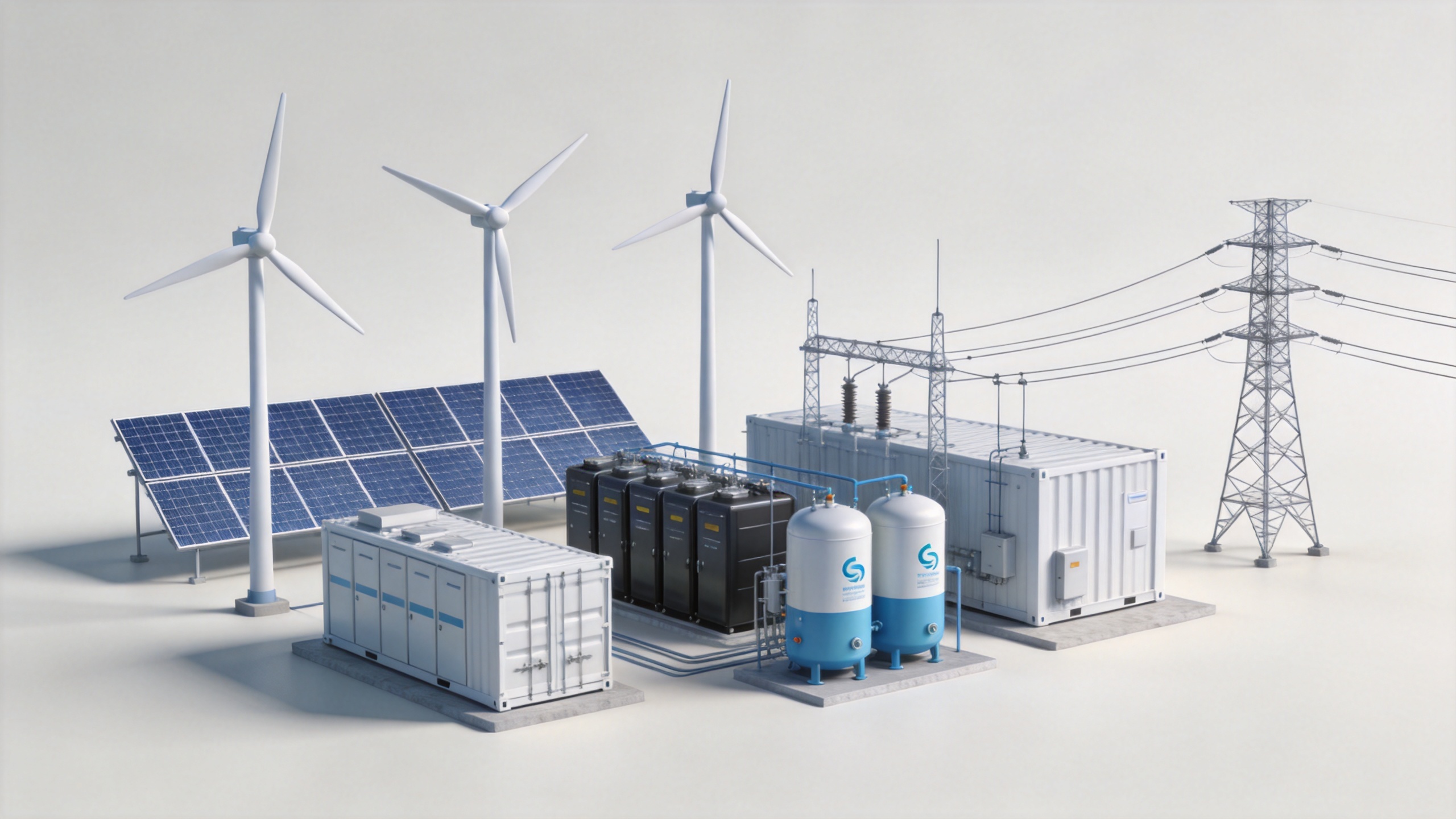
Hydrogen can be considered in this long-duration layer. A hydrogen energy storage system uses electricity to produce hydrogen during periods of surplus renewable output, stores that energy carrier, and later converts or uses it when energy is needed. IRENA notes that long-term hydrogen storage is primarily linked to variation in renewable supply. That makes hydrogen a complement to, rather than a replacement for, short-duration battery storage.
Hydrogen Storage Has a Specific Role in an Integrated Portfolio
Hydrogen is most relevant when the required storage window, energy volume, or application extends beyond frequent daily cycling. It can connect renewable electricity with industrial energy uses, remote systems, and microgrid designs where resilience and duration are central concerns. The value proposition must still be tested carefully: conversion losses, infrastructure requirements, operational strategy, safety processes, and local regulations all affect the result.
For organizations exploring this pathway, an integrated solution can make the interfaces between generation, conversion, storage, control, and end use easier to evaluate. Hyto Energy’s Hydrogen microgrid integrated solution is a relevant example of a system-level approach for considering how hydrogen can support a renewable energy storage architecture. Project teams should validate the actual load profile, renewable resource pattern, operating mode, and site requirements before selecting any configuration.
Storage Must Be Planned With Grids, Not Instead of Grids
It is tempting to frame renewable energy storage as a substitute for network investment. In practice, storage, transmission, distribution upgrades, and demand response are complementary. Storage can reduce stress at specific times and locations, but it cannot solve every constraint caused by insufficient network capacity or inadequate interconnection.
A robust planning process starts with time-series data. Teams should map renewable output, load, congestion, outage risk, and required service levels over representative days and extreme periods. They should then test portfolios rather than single technologies. The result may show that a modest battery, flexible industrial load, and targeted grid upgrade provide more value together than a much larger standalone asset.
How to Frame the Next Renewable Energy Storage Decision
Start with the system problem, then select technologies. Define the hours and events that create risk; separate power requirements from energy-duration requirements; identify which services can be stacked; and evaluate how the solution will operate under both normal and stressed conditions. Include degradation, maintenance, control integration, safety, permitting, and expansion options in the review.
Modern power systems need renewable energy storage because clean electricity becomes more valuable when it can be delivered at the right time and in the right form. Batteries can handle many fast and daily balancing needs, while long-duration approaches such as hydrogen can address a different layer of variability. By matching storage duration and function to a wider grid plan, organizations can turn variable renewable output into a more reliable, flexible, and resilient energy resource.