 EN

What Does a Hydrogen Production Plant Include?
A hydrogen production plant is more than an electrolyzer placed beside a power source. For project teams, the useful way to view a plant is as an integrated chain: electricity and treated water enter the system; hydrogen is generated, conditioned, compressed or stored as required; oxygen and other process streams are handled safely; and controls coordinate every operating state. The exact configuration depends on capacity, hydrogen purity, delivery pressure, site utilities, and the selected electrolysis technology. Still, most industrial projects include the same core systems.
This overview explains the modules normally found in a hydrogen production plant, with particular attention to a hydrogen electrolysis plant. It is intended as an early-stage planning guide rather than a substitute for a project-specific process design.
1. Electrical Supply and Power Conversion
Every water-electrolysis hydrogen production plant begins with an electrical interface. The plant receives power from the grid, renewable generation, a microgrid, or a combination of sources. Transformers, switchgear, protection devices, and power-quality equipment bring that supply into the plant safely. Rectifiers or power converters then provide the direct current required by the electrolyzer.
Power conversion is a balance-of-plant function, not an optional accessory. Its sizing and control logic influence how the system follows changing renewable output, manages start-up and shutdown, and protects sensitive equipment. A project team should define available voltage, expected load profile, ramping requirements, harmonics limits, grounding concept, and backup-power needs before finalizing the electrical architecture.
2. Water Treatment and Feedwater Management
Water is the process feedstock for a hydrogen electrolysis plant, so water quality deserves the same attention as electrical capacity. Raw water may require filtration, softening, reverse osmosis, polishing, and deionization before it reaches the electrolyzer. Storage tanks, pumps, instruments, and control valves then maintain an appropriate flow and quality at the process interface.
An indicative engineering reference commonly used in early discussions is roughly 9 litres of demineralized water per kilogram of hydrogen; actual demand also depends on technology choice, cooling arrangement, operating strategy, and site losses. The practical lesson is simple: include source-water assessment, treatment capacity, wastewater routing, and monitoring points in the first site layout—not after the electrolyzer package is selected.
3. The Electrolyzer System: Where Hydrogen Is Generated
The electrolyzer is the core production unit in a hydrogen production plant. It uses electricity to split water into hydrogen and oxygen. Alkaline, PEM, and AEM designs all perform this fundamental task, but their operating envelopes, balance-of-plant interfaces, and control requirements can differ. The stack is usually supplied with supporting modules for electrolyte or water circulation, temperature management, gas separation, instrumentation, and local control.
For a scalable project, the electrolyzer package should be assessed as part of the whole plant rather than in isolation. Teams need to check usable operating range, maintenance access, expected utility connections, ventilation requirements, control signals, and expansion philosophy. Where capacity calls for a larger modular solution, a 1MW-5MW system can be considered within the wider site engineering plan; the final configuration should be verified against the project duty and interfaces.
4. Gas Separation, Drying, and Purification
Hydrogen leaving the generation section is not automatically ready for every downstream use. The gas-handling train typically separates process gases, removes entrained moisture, manages condensate, and confirms product quality. Depending on the required specification, the plant may include separators, coolers, dryers, filters, purification equipment, sampling points, analyzers, and pressure-control devices.
This is where the end use shapes the design. A plant supplying a local industrial process, a storage system, a pipeline, or a fuel application may require different purity targets and verification practices. Rather than treating purification as a generic add-on, define the delivery specification early and trace it backwards through the compression, drying, separation, and electrolyzer interfaces.
5. Cooling and Thermal Management
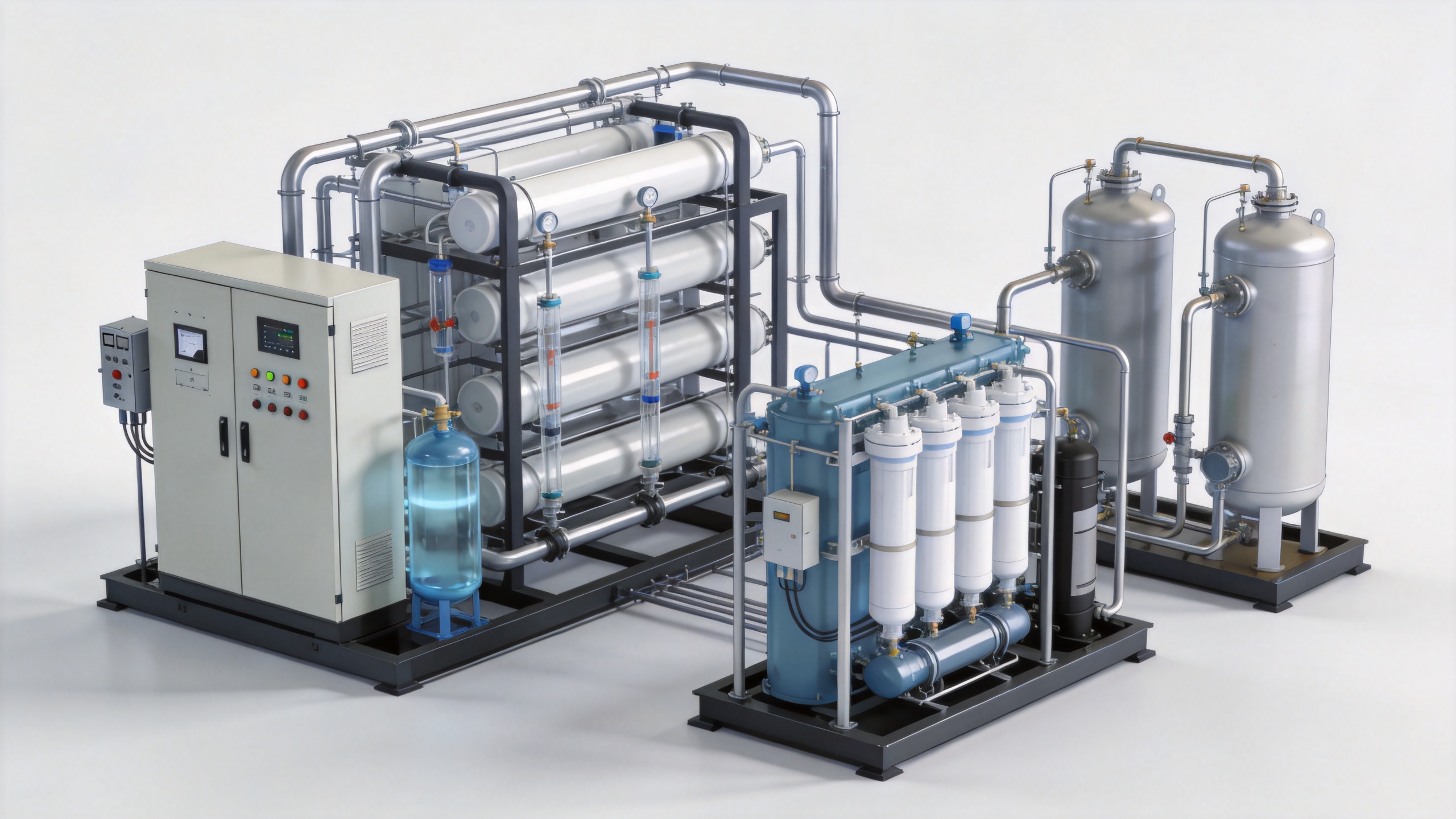
Electrolysis produces heat that must be managed to keep equipment within its operating range. A hydrogen production plant may use a closed-loop cooling circuit, heat exchangers, pumps, expansion vessels, a dry cooler, a cooling tower, or a site-wide utility connection. The selected solution depends on climate, water availability, temperature requirements, installed capacity, and whether useful heat recovery is practical.
Thermal management has strong links to water treatment, electrical loading, and plant availability. It should therefore be reviewed with the complete process model. In early layouts, allow space for heat-rejection equipment, maintenance clearances, pipe routes, drainage, and winterization measures where relevant.
6. Compression, Buffering, and Hydrogen Storage
After conditioning, hydrogen may be delivered at relatively low pressure, compressed for storage or distribution, or routed to a downstream process. The choice drives the next group of systems: compressors, interstage cooling, pressure vessels, buffer tanks, manifolds, valves, pressure regulation, and metering. Some projects also integrate alternative storage pathways, such as solid-state storage, when the broader energy-management concept supports it.
Storage and compression should be sized around demand patterns, not just daily production. Questions to resolve include: When will hydrogen be consumed? What delivery pressure is required? How much buffer is needed during production changes? Which maintenance scenario sets the minimum reserve? Clear answers help prevent a well-sized electrolyzer from becoming constrained by an undersized downstream gas-handling section.
7. Oxygen Handling and Auxiliary Process Systems
Electrolysis also produces oxygen. A complete hydrogen production plant needs a defined oxygen-handling route, which may include safe venting, collection, monitoring, or a separately engineered utilization option. The appropriate route is site-specific and must be designed with applicable regulations and hazard analysis in mind.
Other auxiliary systems commonly include nitrogen purging, instrument air, drains, condensate collection, chemical handling where applicable, ventilation, lighting, maintenance utilities, and fire-protection interfaces. These are easy to underestimate in a concept drawing, yet they often determine the footprint, utility load, and commissioning sequence of a hydrogen electrolysis plant.
8. Controls, Automation, and Plant Data
A hydrogen production plant needs a coordinated control layer to turn individual packages into a functioning facility. This may include a PLC or DCS, local panels, safety instrumented functions, sensors, analyzers, alarms, historian connections, and remote monitoring interfaces. The control strategy should coordinate power conversion, water supply, electrolyzer operation, thermal management, gas treatment, compression, storage, and emergency states.
For renewable-linked projects, the controls strategy is especially important. It should define how the plant responds to power variability, communication loss, maintenance overrides, abnormal gas readings, and restart conditions. Establishing the signal list and operating philosophy early reduces later integration work between package vendors and the site team.
9. Safety, Ventilation, and Emergency Systems
Hydrogen is a flammable gas, so safety systems are integral to—not separate from—the hydrogen production plant. Typical layers include gas detection, pressure monitoring, emergency shutdown logic, ventilation, classified electrical design where required, relief devices, vent routing, fire and gas interfaces, access control, procedures, and training. The detailed requirements vary by jurisdiction, plant layout, pressure class, and applicable codes.
The strongest safety outcome comes from connecting the layers. A detector must have a defined alarm response; a relief device needs a safe discharge path; a shutdown action must leave each package in a verified state. Hazard studies, site-specific standards review, and clear responsibility boundaries are essential before construction.
How to Turn the Equipment List into a Buildable Project
For an awareness-stage project discussion, start with the complete system map rather than a single equipment quotation. Define the hydrogen demand profile, target purity and pressure, power source, water source, available footprint, climate conditions, site utilities, permitting context, and integration responsibilities. Then develop the process flow, utility balance, control narrative, and interface schedule around the selected electrolyzer technology.
In short, a modern hydrogen production plant includes the generation unit plus the electrical, water, gas-conditioning, thermal, storage, controls, and safety systems that allow it to operate as a dependable facility. Looking at these systems together gives project teams a clearer path from a hydrogen target to an implementable plant concept.