
 EN

Solar-to-Hydrogen System Design: Managing Variable Renewable Power
For project teams planning hydrogen production using solar energy, the difficult part is rarely proving that photovoltaic power can run an electrolyzer. The engineering challenge is coordinating a power source that changes by the minute with equipment that has preferred operating windows, gas-quality safeguards, and a hydrogen demand profile that may not change at all. A workable solar-to-hydrogen design therefore treats the plant as a hydrogen microgrid, not as a PV array connected directly to a stack.
In other words, hydrogen production using solar energy should be specified as a controlled operating system. The project brief needs to state how variable DC power will be accepted, stabilized, curtailed, or stored; when the electrolyzer may ramp or pause; and which hydrogen-delivery obligation has priority. Defining these rules at concept stage makes later equipment comparisons meaningful.
From a system-integration perspective, start with the operating boundary: is the objective to maximize renewable hydrogen, provide a dependable hydrogen supply, absorb curtailed solar power, or balance several of these goals? The answer determines the role of the electrolyzer, electrical buffer, hydrogen storage, compression, and energy-management system (EMS).
Why variable solar power changes the design problem for hydrogen production using solar energy
PV output follows irradiance and temperature, while an electrolyzer has technology-specific limits for start-up, turndown, ramping, pressure, temperature, and gas handling. In practical hydrogen production using solar energy, low or rapidly changing input power can affect the operating conditions around voltage, temperature, pressure, and gas separation. A recent review of PV-powered electrolysis also notes that very low-current operation can increase gas-crossover concerns; the actual minimum stable load must be verified with the chosen technology and supplier.
That makes peak PV output a poor sizing shortcut. A large array may provide strong midday production yet leave the stack operating below its preferred range in the morning, late afternoon, or during passing cloud. Conversely, sizing only for a high electrolyzer nameplate rating can leave capital underused. The key question is not “How much solar capacity is installed?” but “How often can the integrated plant operate safely and productively within its agreed dispatch envelope?”
Define the electrolyzer operating window for hydrogen production using solar energy
For hydrogen production using solar energy, the design basis should include a time-series view of solar resource, expected curtailment, auxiliary loads, water treatment, compression demand, and delivery commitments. Use at least the following controls and constraints in the model:
- Minimum stable load: the verified threshold below which the system should reduce output, enter standby, or shut down.
- Ramp limits and restart logic: how fast the stack and balance-of-plant may respond without exceeding approved operating conditions.
- Power quality and DC-bus behavior: how converters, batteries, and controls maintain acceptable voltage and current during PV fluctuations.
- Auxiliary consumption: water conditioning, cooling, controls, drying, compression, and safety systems must remain available even when solar generation drops.
- Hydrogen quality and pressure management: gas processing and storage controls need to follow the selected production profile.
A useful review checkpoint is to compare three dispatch cases: direct PV-following operation, PV plus electrical buffer, and PV plus electrical and hydrogen buffers. This comparison makes trade-offs visible before a project locks in component sizes.
Use two buffers to stabilize hydrogen production using solar energy
Battery storage and hydrogen storage solve different problems. A battery or DC-link buffer can smooth short-duration power excursions and help the electrolyzer stay inside its preferred window. Hydrogen storage decouples production from delivery: it allows the plant to produce when renewable power is available and supply users later at a steadier flow. In a hydrogen microgrid, the two buffers are complementary rather than interchangeable.
For example, a short PV dip may be handled by the electrical buffer or a controlled ramp-down. A longer cloudy period may require the EMS to stop electrolysis, protect essential auxiliaries, and draw from stored hydrogen for downstream demand. The required storage duration should come from the delivery profile and site constraints, not from a generic rule of thumb.
| Design question | Electrical buffer focus | Hydrogen buffer focus |
|---|---|---|
| What does it manage? | Fast power variation and start/stop transitions | Mismatch between production timing and hydrogen demand |
| Typical control horizon | Seconds to hours, depending on design | Hours to longer demand cycles, depending on storage and logistics |
| Key verification point | Electrolyzer operating window and converter limits | Pressure, delivery profile, compression, safety, and storage route |
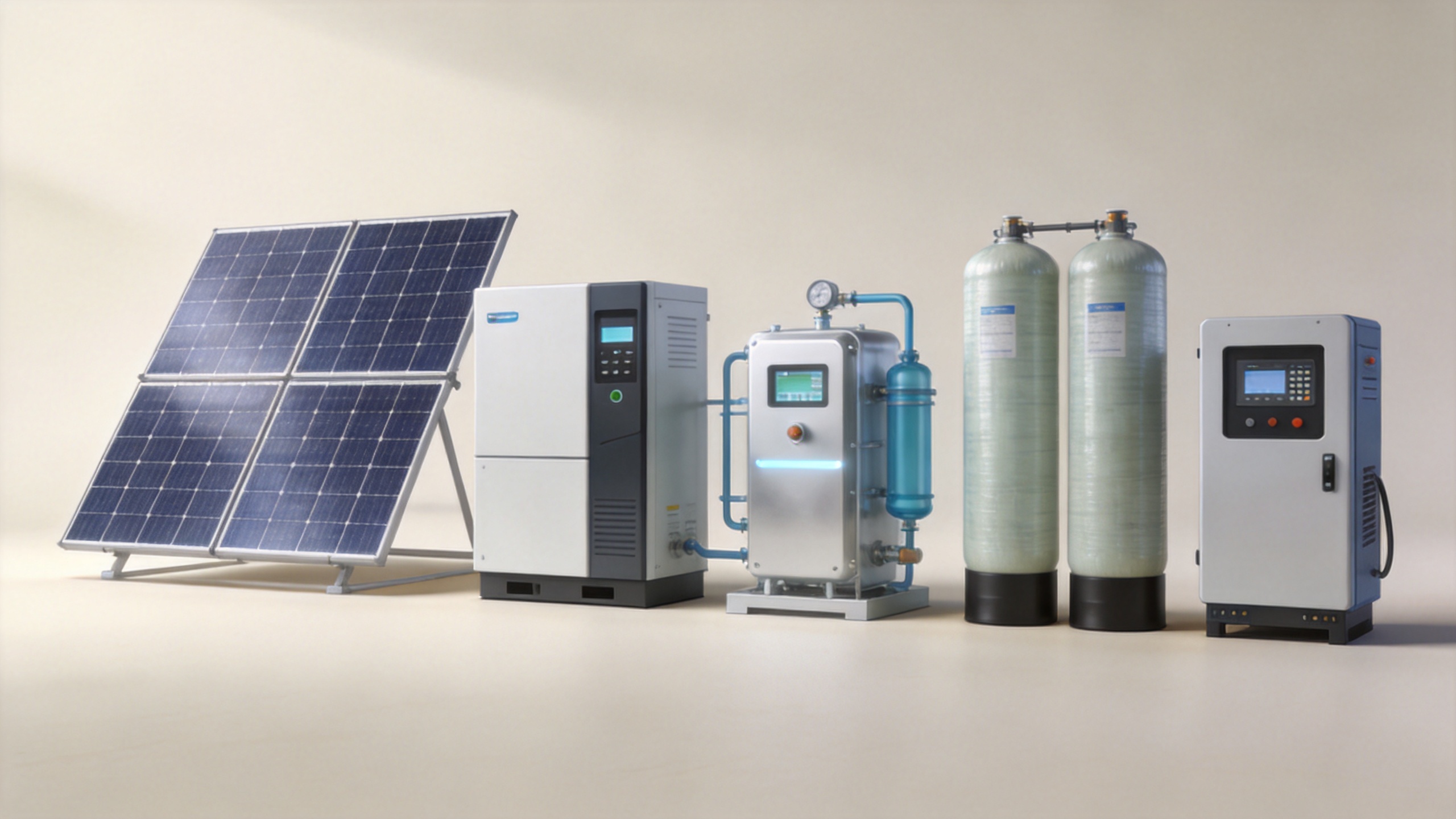
Build the EMS for controlled hydrogen production using solar energy
The EMS is the decision layer for hydrogen production using solar energy. It should continuously compare measured PV power, short-term forecast, battery state, electrolyzer state, hydrogen inventory, delivery commitments, and safety interlocks. Rather than simply sending all available solar power to the electrolyzer, it should choose among controlled ramping, hold-at-load operation, standby, storage charging, compression scheduling, and demand support.
A practical priority sequence can be: maintain safety-critical auxiliaries; keep the electrolyzer within approved limits; use a limited electrical buffer for short transients; produce and condition hydrogen when conditions are stable; then allocate surplus energy according to the project’s curtailment, storage, and delivery rules. Those priorities are site-specific; recording them early keeps control logic from becoming an afterthought.
One practical caution: a higher instantaneous solar input does not automatically improve the system outcome. If compression, storage pressure, or downstream demand is constrained, the EMS may need to curtail, redirect, or delay production. System performance has to be assessed across the full chain.
Compare architectures for hydrogen production using solar energy
At the consideration stage, project teams can compare architectures with the same load and solar data rather than comparing isolated equipment ratings. A direct-coupled arrangement can reduce components but places more responsibility on electrolyzer flexibility and PV matching. Adding a battery or DC buffer can improve controllability but introduces additional capital, cycling, and maintenance considerations. Adding sufficient hydrogen storage supports delivery continuity but requires a clear storage route and operating philosophy.
For a broader reference point, a hydrogen microgrid integrated solution can be evaluated as a system boundary that brings power generation, electrolysis, storage, and dispatch discussions into one planning framework. Where a project’s production range is under consideration, the site’s 100KW-500KW solution page can also serve as a starting point for an application-specific technical conversation; final configuration still depends on verified solar data, hydrogen demand, interfaces, and local requirements.
A design checklist for hydrogen production from solar energy
- Collect at least one representative year of PV and demand time-series data, including seasonal and intraday variation.
- Confirm the selected electrolyzer’s approved turndown, ramp, restart, water-quality, and gas-handling requirements in writing.
- Model electrical and hydrogen storage separately, then test how each changes delivery reliability and operating hours.
- Define EMS priorities, alarm actions, communications interfaces, and fallback states before commissioning.
- Assess compression, drying, storage pressure, and delivery equipment as part of the same dynamic system.
- Review site safety, permitting, grid interconnection, water supply, and maintenance access with qualified local parties.
Design for coordination in hydrogen production using solar energy
Reliable hydrogen production from solar energy comes from coordinated operation rather than a single oversized component. The most robust projects first establish the hydrogen demand, renewable resource, operating window, and buffering strategy; they then optimize PV capacity, electrolyzer rating, battery support, hydrogen storage, and EMS settings around those conditions.
Before selecting equipment, turn the checklist into a site-specific dispatch model and validate the assumptions with the relevant technology providers. This lets project teams judge when direct PV-following is sufficient, when an electrical buffer is justified, and how much hydrogen inventory is needed to make variable renewable generation serve a dependable supply.