
 EN

Renewable Energy Storage Types for Industrial Project Planning
Industrial teams evaluating ways to store renewable energy are usually solving a timing problem rather than simply buying a storage device. Solar and wind output may be available when a plant does not need it; the project must then decide whether to shift electricity for minutes, hours, days, or a longer seasonal interval. The practical answer depends on load shape, site conditions, energy mediums, and the connection boundarys required around the storage asset.
From a system-integration perspective, it is more useful to begin with the operating boundary than with a technology name. A battery, thermal store, pumped-hydro scheme, compressed-air system, or hydrogen pathway can all be valid ways to store renewable energy, but they do not solve the same industrial problem. This overview maps the main options and the questions that make an early project discussion more actionable.
Why storage type matters in an industrial renewable-energy plan
Renewable generation is variable, while industrial processes often have defined power, heat, gas, and production schedules. Storage creates flexibility by capturing surplus energy and returning it later in the form the process can use. Before comparing equipment, define the service required: rapid power support, daily load shifting, resilient backup, heat supply, or an energy reserve that may be held for several days.
A useful distinction is between power and duration. Power indicates how quickly a system can charge or discharge; duration indicates how long it can sustain that output. NREL’s storage-characteristics overview places flywheels at very short, high-power duties, batteries and thermal systems around hour-scale duties, and pumped hydro or hydrogen among options considered for longer duration. That map is directional, not a substitute for a project-specific design calculation.
Electrical storage: batteries, flywheels, and capacitors
Electrochemical batteries are among the most familiar ways to store renewable energy when a site needs fast response and daily cycling. They can support peak management, renewable smoothing, and short backup windows. For an industrial project, the planning questions include required discharge duration, cycling pattern, ambient conditions, safety design, fire-protection connection boundarys, maintenance access, and how the system will connect to the site electrical architecture.
Flywheels and supercapacitors address a different part of the problem. Their strength is rapid response and frequent cycling, so they may fit power-quality or brief ride-through duties. They are not normally the first choice when the goal is to move a large volume of energy across a multi-day renewable shortfall. A sound clean energy storage solutions study therefore avoids treating every electrical-storage technology as interchangeable.
Mechanical storage: pumped hydro and compressed air
Pumped-storage hydropower moves water between elevations, storing energy as gravitational potential. It can be a strong option where geography, water management, permitting, and grid-scale operating needs align. Yet these same conditions mean it is not a drop-in solution for every factory or industrial park. Reservoir siting, civil works, environmental review, transmission access, and long development timelines need early attention.
Compressed-air energy storage uses surplus power to compress air and later expands it through a power-generation process. It is another route for projects that can support the necessary underground or engineered storage volume and balance-of-plant equipment. When assessing these ways to store renewable energy, ask first whether the site can accommodate the physical storage medium and supporting infrastructure; otherwise, an efficiency comparison alone can be misleading.
Thermal storage: storing heat instead of electricity
Many industrial facilities consume heat as well as electricity. Thermal storage captures energy in a medium such as water, high-temperature storage medium, or another suitable material and releases it as useful heat or, in some system designs, electricity. Its relevance rises when the plant has a defined thermal load, an available charging source, and a clear temperature requirement.
This option changes the planning conversation. Rather than converting stored electricity back into power by default, the project can ask whether surplus renewable energy can serve a heat process directly. The key checks are charge and discharge temperatures, process integration, insulation and heat-loss management, control strategy, and the value of the displaced fuel or electricity. These details determine whether thermal storage belongs in the short list of ways to store renewable energy for that site.
Hydrogen energy storage for longer-duration flexibility
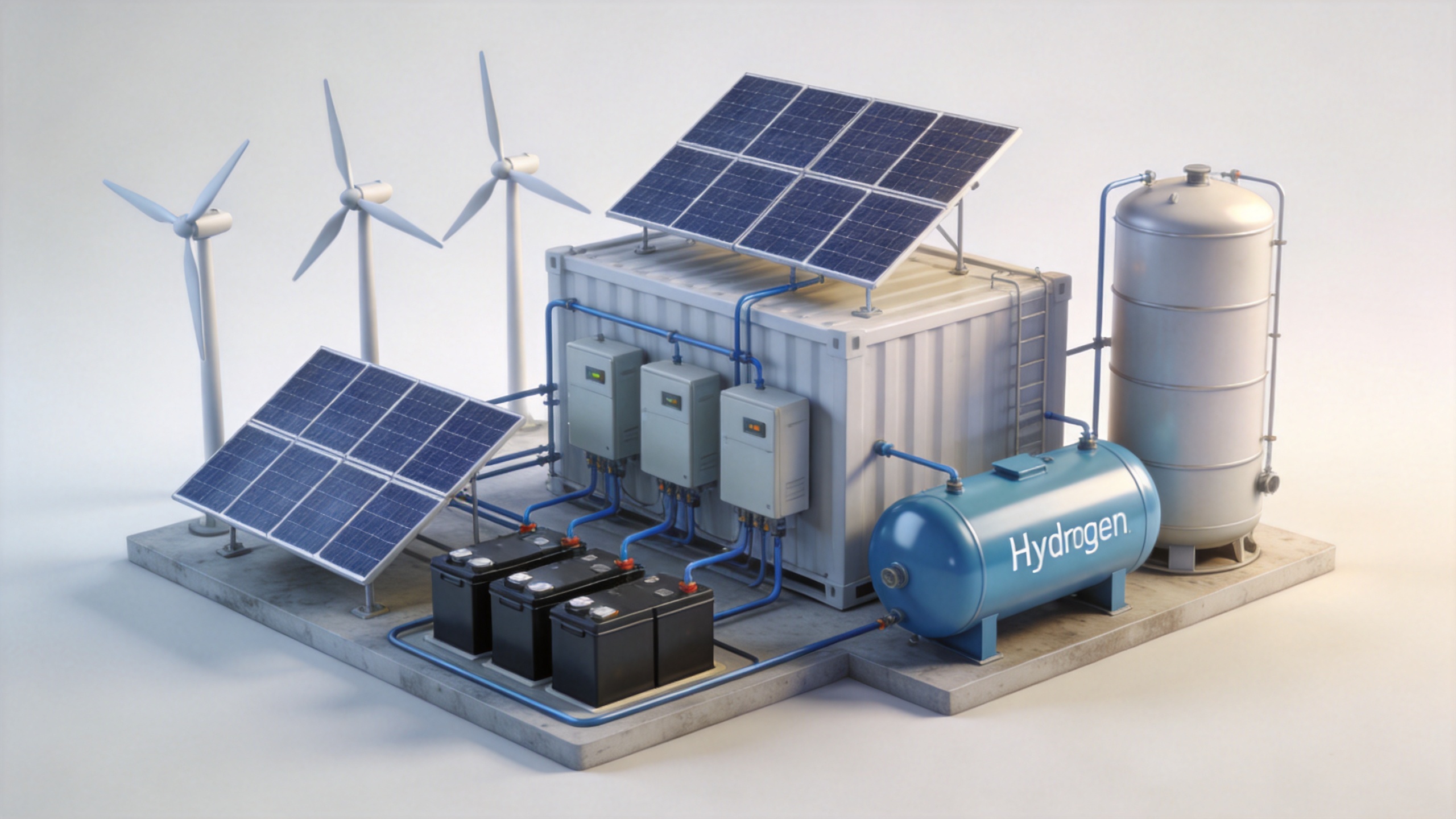
Hydrogen is an energy medium rather than a battery. In a renewable-energy system, electricity can power an electrolyzer, hydrogen can be stored, and the hydrogen can later serve a process, a vehicle-fueling need, or a power-generation pathway. This separates the timing of renewable generation from the timing of hydrogen use and can be relevant where a project needs longer-duration flexibility or a hydrogen end use.
The U.S. Department of Energy describes hydrogen storage broadly as physical storage, including high-pressure tanks and liquid hydrogen, as well as materials-based approaches. The appropriate route depends on the operating pressure, site footprint, safety engineering, delivery format, and use profile. DOE discussions of long-duration storage also examine hydrogen alongside pumped hydropower, flow batteries, compressed air, and thermal storage for durations above 12 hours and up to several days. That does not make hydrogen the universal answer; it highlights why duration and end use should drive the comparison.
For teams exploring a hydrogen pathway, a product conversation should begin with confirmed project conditions, not assumed specifications. The Mega hydrogen storage unit can be a relevant starting point for discussing an industrial hydrogen-storage connection boundary. Before requesting a quotation, define the renewable-power profile, hydrogen production or supply route, storage requirement, downstream consumption, target operating conditions, controls, site layout, and delivery expectations.
A comparison framework for clean energy storage solutions
| Storage type | Typical planning fit | Early questions to resolve |
|---|---|---|
| Batteries | Fast response, daily shifting, short backup | Duration, cycling, safety, electrical interconnection |
| Flywheels / supercapacitors | Power quality and brief ride-through | Response duty, event frequency, required energy volume |
| Pumped hydro | Large-scale, long-duration storage where geography fits | Elevation, water, civil works, permitting, grid access |
| Compressed air | Longer-duration storage with suitable physical infrastructure | Storage volume, thermal management, generation connection boundary |
| Thermal storage | Sites with useful heat demand | Temperature range, process integration, heat losses |
| Hydrogen storage | Longer-duration flexibility or a hydrogen end-use pathway | Production route, storage method, safety, consumption profile |
The table is a screening tool, not a ranking. If the first requirement is sub-second response, the shortlist will differ from a project that must bridge several days of low renewable output. More accurately, the right choice emerges after the load profile and system boundary are confirmed.
Questions to settle before an industrial inquiry
- What renewable source is available, and how variable is its output?
- What energy form is needed after storage: electricity, heat, hydrogen, or another process input?
- What power level and storage duration define the required service?
- Which site constraints apply to footprint, water, geology, ventilation, safety zones, and grid interconnection?
- How will the storage system connection boundary with generation, controls, and downstream equipment?
- Which technical documents, delivery boundaries, and acceptance requirements should suppliers address?
These questions help convert a broad interest in ways to store renewable energy into a project brief that suppliers and engineering teams can evaluate consistently.
Move from a technology list to a usable project boundary
The value of comparing renewable storage types is not to declare one option most suitable. It is to match an energy-shifting task to a workable technical and commercial boundary. Batteries may be appropriate for short, responsive electrical duties; thermal storage may fit a heat-led process; pumped hydro and compressed air depend heavily on site conditions; hydrogen can connect renewable power with a longer-duration storage or industrial-use pathway.
For an awareness-stage project, start with the load profile, intended energy output, and operating timeline. Then use those facts to narrow the ways to store renewable energy that deserve technical review. This sequence gives the procurement conversation a clearer basis and makes clean energy storage solutions easier to compare without overstating any technology’s fit.