
 EN

Metal Hydride Storage System Requirements for Industrial Integration
Industrial teams evaluating a metal hydride storage system usually begin with storage capacity, but integration success depends on much more: usable footprint, thermal duty, hydrogen interfaces, controls, and maintainable safety layers. A solid-state hydrogen storage project should therefore be treated as a system-engineering exercise rather than a vessel-selection exercise.
This guide is written for B2B project teams comparing a metal hydride storage system with other stationary hydrogen storage options. It focuses on the questions that should be answered before equipment layout, procurement, and commissioning are finalized.
Start with the operating case, not the nameplate capacity
A metal hydride storage system stores and releases hydrogen through reversible material reactions. That behavior makes the duty cycle decisive. Define how much hydrogen must be available, at what delivery pressure, for how long, and how often the system must charge and discharge. A design that works well for a slowly cycled backup load may need a different thermal and control approach for frequent fuel-cell support or microgrid balancing.
- Map the hydrogen source, including expected pressure, purity, flow variation, and available compression or regulation.
- Map the hydrogen consumer, including minimum inlet pressure, peak and average flow, ramp rate, and permitted interruption time.
- Set the usable storage window rather than relying only on a nominal hydrogen inventory.
- Document ambient conditions, indoor or outdoor siting, utility availability, and expected service access.
These inputs let engineering teams compare a hydrogen storage system on delivered hydrogen performance rather than on a single capacity figure.
Make thermal management an installation requirement
Thermal design is central to metal hydride storage system integration. Hydrogen absorption releases heat, while hydrogen desorption typically requires heat input. If the heat path is undersized or poorly controlled, the system may not meet the intended charging or delivery rate even when its nominal storage capacity is appropriate.
Specify the heat-transfer medium, supply temperature range, return conditions, available thermal power, and control response for each operating mode. The project team should also decide whether the system will use dedicated heating and cooling equipment, a shared plant loop, or an available low-grade heat source. Each option affects uptime, control boundaries, redundancy, and commissioning scope.
| Integration question | Why it matters | What to define early |
|---|---|---|
| Charge-side heat removal | Absorption heat can limit fill rate | Cooling medium, temperature, flow, and fault response |
| Discharge-side heat input | Desorption heat affects hydrogen delivery | Heat source capacity, startup time, and backup mode |
| Temperature measurement | Bed temperature informs safe, repeatable control | Sensor locations, alarm limits, calibration, and data logging |
| Seasonal conditions | Ambient changes affect utilities and enclosure decisions | Design ambient range, insulation, freeze protection, ventilation |
Plan the footprint around service access and utility routing
The high volumetric density associated with a metal hydride storage system can be attractive where a site has limited space. That advantage should not be confused with a minimal installation envelope. A practical layout needs clearance for modules, valves, filters, sensors, heat-transfer connections, electrical cabinets, and inspection tasks.
Review the route for hydrogen piping, thermal lines, drains where applicable, electrical supply, communications, ventilation, and emergency access before placing equipment. Module replacement and isolation procedures should be considered at the same time. A compact hydrogen storage system is most valuable when it remains accessible for routine checks and planned maintenance.
Define hydrogen, process, and control interfaces clearly
Interface ambiguity is a common cause of schedule and commissioning issues. A metal hydride storage system should have a documented boundary for hydrogen supply, outlet delivery, purge or vent arrangements where applicable, thermal utilities, power, control signals, and emergency shutdown functions.
For a stationary project, specify normal operating ranges and the required behavior outside those ranges. Examples include low inlet pressure, loss of cooling during charging, loss of heat during delivery, a sensor disagreement, or a downstream fuel-cell trip. The controls architecture should show which protective actions are local to the storage package and which are coordinated with the broader plant.
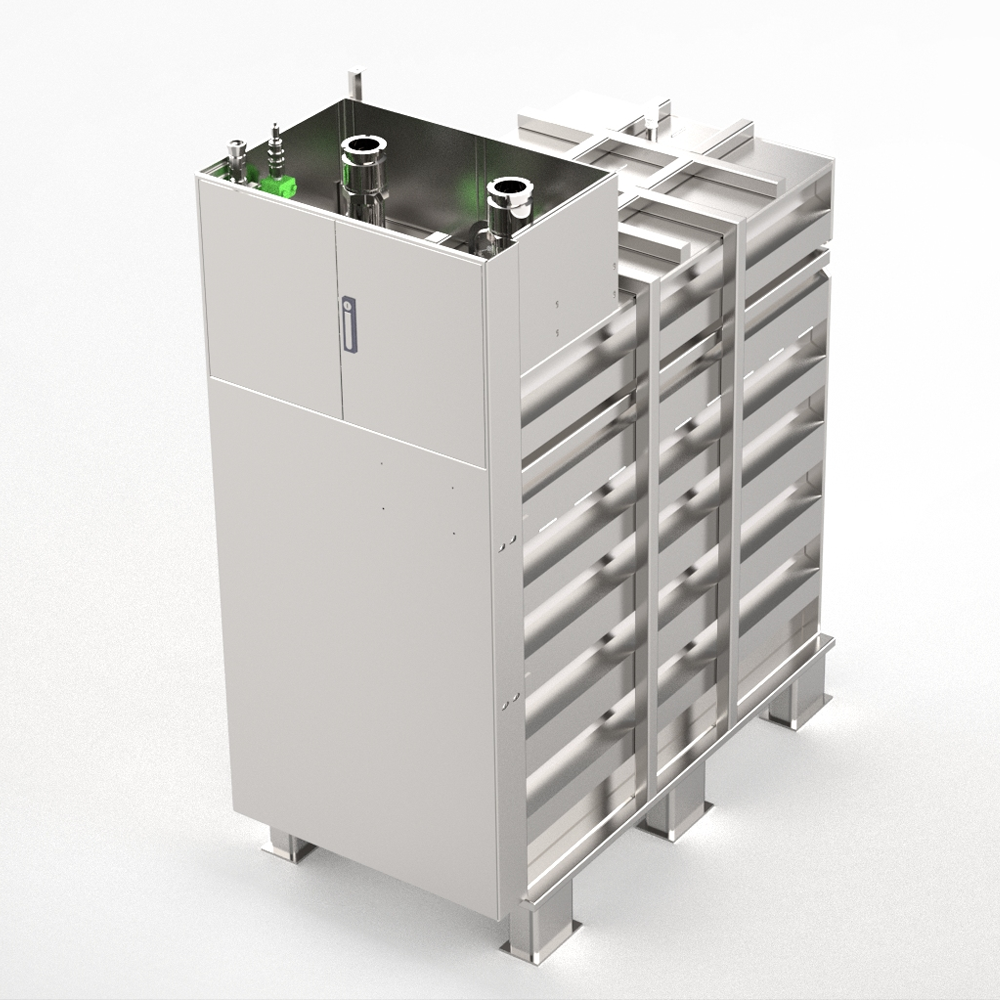
Where a project requires an equipment reference, the confirmed site product page for the Mega hydrogen storage unit can be used as a starting point for a supplier discussion. The final configuration should still be matched to the site duty cycle and interface requirements.
Build safety into the design review and operating procedures
Lower storage pressure can be an important consideration when comparing storage routes, but it does not remove the need for a complete hydrogen safety assessment. The metal hydride storage system design review should address the material, enclosure, piping, pressure-relief path, detection coverage, ventilation, electrical classification, emergency isolation, and operating procedures as one integrated package.
- Use qualified engineering review against applicable local codes, standards, and authority requirements.
- Define hydrogen detection, alarm escalation, ventilation response, and emergency shutdown logic.
- Confirm relief routing and the interaction between pressure protection and abnormal-temperature scenarios.
- Establish inspection, leak-checking, isolation, and restart procedures before site acceptance testing.
- Train operators on normal cycling, alarm response, planned maintenance, and changes to the connected process.
The right safety strategy is site-specific. It must be verified by competent professionals using the actual material selection, equipment design, and installation conditions rather than copied from a generic layout.
Use a commissioning plan that proves the integrated duty cycle
Factory documentation is useful, but industrial acceptance should also prove the installed metal hydride storage system in its real thermal, hydrogen, and controls environment. Commissioning tests should cover leak integrity, instrumentation, interlocks, alarms, utility loss response, controlled charge and discharge sequences, and the expected handoff to the hydrogen user.
For consideration-stage procurement, request an interface matrix and an acceptance-test outline early. This makes it easier to compare a hydrogen storage system proposal on lifecycle fit, not simply on hardware scope. It also clarifies which responsibilities belong to the storage supplier, EPC contractor, controls integrator, and site operator.
Industrial integration checklist
- Define hydrogen demand, delivery pressure, flow profile, and required autonomy.
- Size charge and discharge thermal duties for the actual cycle profile.
- Confirm the installation footprint, access clearances, utility routes, and lifting plan.
- Freeze process, mechanical, electrical, controls, and emergency-interface boundaries.
- Complete a site-specific safety and compliance review with qualified engineers.
- Commission the complete system through representative operating and upset scenarios.
A metal hydride storage system can support compact, solid-state hydrogen storage when its thermal behavior and plant interfaces are engineered from the first layout review. A disciplined requirements package gives industrial teams a clearer basis for selecting equipment, coordinating suppliers, and bringing a dependable system into operation.