
 EN

Metal Hydride Hydrogen Storage Tanks: Procurement Requirements Checklist
Buying a metal hydride hydrogen storage system is not a matter of comparing vessel volume alone. For project teams evaluating solid-state hydrogen storage, the practical question is whether a quoted system can deliver the required hydrogen at the required rate, temperature, purity and interface conditions. A disciplined request-for-quotation process makes those conditions visible before a purchase order is issued.
This checklist is written for B2B buyers, system integrators and project owners. It turns a broad metal hydride hydrogen storage specification into evidence a supplier can provide, review and stand behind. The aim is not to prescribe one alloy or one vessel design; it is to prevent a mismatch between a nominal capacity claim and the usable duty of the installation.
1. Define the duty before comparing a metal hydride storage tank
Start with the hydrogen consumer rather than the tank. State the normal and peak withdrawal flow, required delivery-pressure range, daily operating hours, expected cycling pattern, permitted start-up time and minimum site temperature. Then identify whether the unit will be stationary, transportable, indoor, outdoor or integrated into a larger hydrogen-energy package.
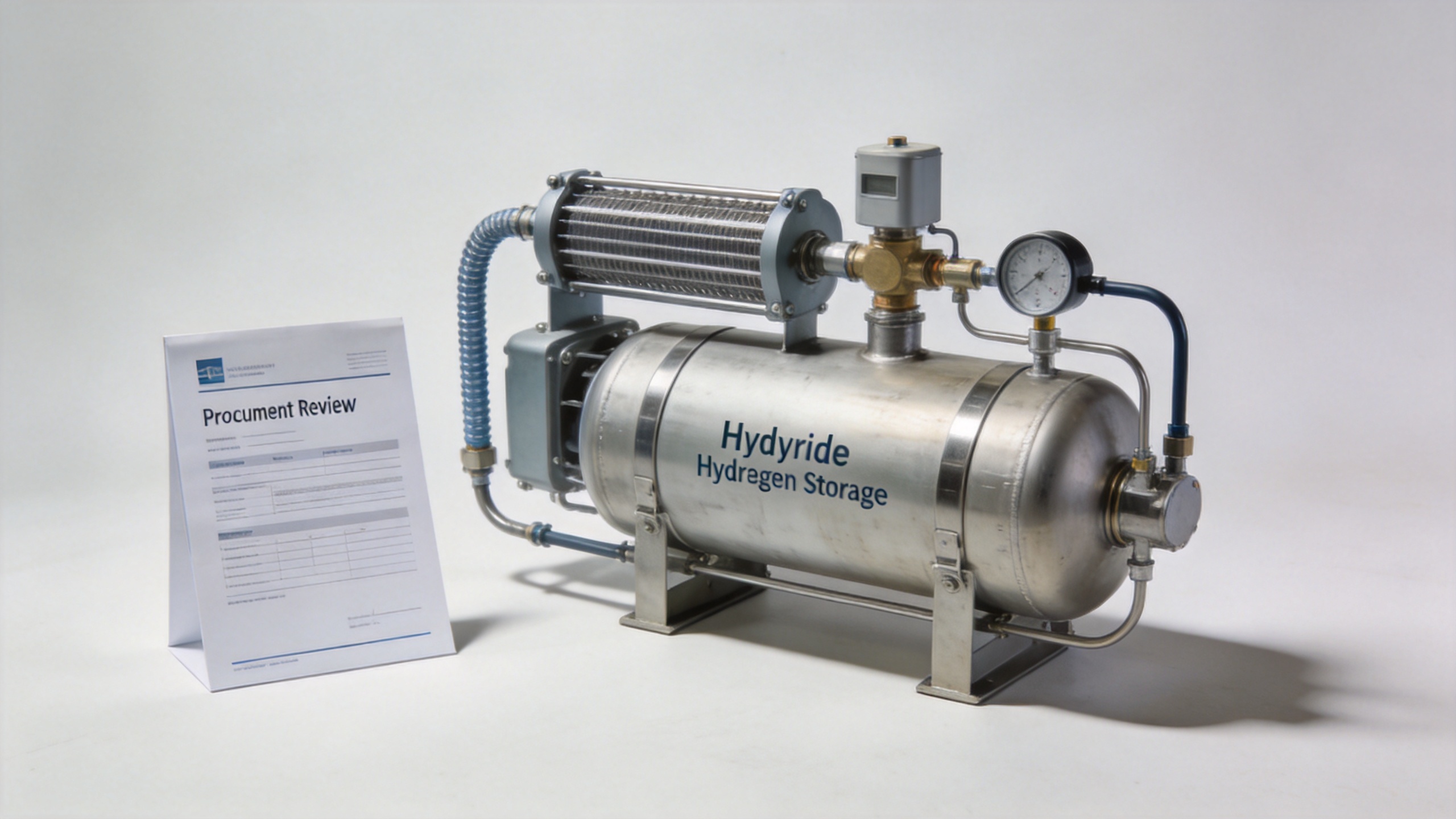
A metal hydride storage tank can be attractive where compact, low-pressure solid-state storage is relevant, but usable performance depends on heat flow and operating conditions. Ask every supplier to describe the capacity basis in the quotation: the reference temperature, charging pressure, discharge pressure, residual hydrogen assumption and the point at which delivery is considered complete. “Stored hydrogen” and “hydrogen available to the load” should not be treated as interchangeable figures.
- Required usable hydrogen per cycle and per day
- Normal, peak and transient hydrogen-flow demand
- Charging source pressure, purity and temperature
- Delivery pressure, minimum flow and end-of-discharge condition
- Ambient range, installation location and permitted footprint
2. Request capacity and performance evidence, not only a nameplate number
For metal hydride hydrogen storage, capacity must be read together with kinetics and thermal management. Hydrogen absorption releases heat; desorption needs heat. A tank that meets a capacity figure under a favorable test condition may not meet a site’s delivery schedule if the heating or cooling interface is undersized. Request a duty-point table rather than a single headline value.
| Requirement to clarify | Evidence to request | Why it matters |
|---|---|---|
| Usable hydrogen capacity | Test basis, temperature range, pressure range and residual-gas definition | Prevents comparison of unlike capacity claims |
| Charge and discharge rate | Flow-versus-temperature curves and stated boundary conditions | Shows whether the tank can follow the actual load |
| Cycle behavior | Declared cycle protocol, degradation assumptions and maintenance actions | Supports lifecycle planning |
| Thermal duty | Required heating/cooling medium, temperatures, flow and connection sizes | Determines whether site utilities can support operation |
In practice, the first comparison meeting is often more useful when the buyer asks, “What conditions produced this result?” than when they ask, “What is your largest model?” This is particularly important for a metal hydride storage tank serving variable loads.
3. Verify design, safety and conformity documentation
Documentation should be an evaluated line item, not an appendix requested after selection. ISO 16111:2018 covers requirements applicable to the material, design, construction and testing of transportable hydrogen gas storage devices in which hydrogen is absorbed in reversible metal hydride. Its applicability depends on the device, configuration and destination market, so the buyer should ask the supplier to identify the exact standard, regulatory route and edition applicable to the quoted scope.
For every metal hydride hydrogen storage quotation, request a document register covering the vessel, hydride material, valves, instrumentation, relief devices, piping interfaces and control logic. Ask which tests are performed on the delivered configuration and which test results are inherited from a component or a representative design. If the unit will cross borders or enter a regulated installation, assign responsibility for local compliance early.
- General arrangement drawing, P&ID and connection schedule
- Design pressure and temperature limits for each pressure boundary
- Material traceability and manufacturing/test records where applicable
- Pressure-relief philosophy, vent-routing requirements and set points
- Leak-test, functional-test and factory-acceptance-test procedure
- Hazard information, operating manual and emergency instructions
4. Treat thermal management and controls as procurement requirements
Heat transfer, pressure control and material stability are core operating topics for metal hydride hydrogen storage. They should appear in the technical clarification list, not be left for site commissioning. Specify the available thermal utility—such as hot water, glycol loop or electric heating—along with allowable supply temperature, return temperature, flow and control range. Also confirm whether the tank requires cooling while charging and whether that cooling duty is continuous or intermittent.
Ask how controls protect the system when hydrogen temperature, pressure, flow, utility availability or sensor readings leave their specified range. A suitable response identifies alarms, trips, restart conditions, manual interventions and the data points exposed to the site control system. It should also distinguish between the supplier’s packaged controls and the buyer’s plant-level safety responsibilities.
5. Confirm hydrogen quality, interfaces and integration boundaries
A purchase specification for a metal hydride storage tank should state the permitted incoming-hydrogen composition and the expected outlet-quality requirements. Do not assume that an upstream electrolyzer, compressor or distribution line automatically produces the conditions accepted by the hydride system. Ask for impurity limits, filtration requirements, moisture-control requirements and the supplier’s procedure for responding to off-spec gas.
Interface clarity reduces late-stage changes. Confirm flange or fitting standards, electrical supply, communications protocol, instrument signals, drainage and ventilation needs, lifting points, access clearances and maintenance isolation points. If the system is being integrated with a larger storage package, document which party owns pressure regulation, gas analysis, vent piping, emergency shutdown and performance acceptance.
When reviewing package options, buyers can compare the site’s hydrogen-storage layout with products such as the Hydrogen energy capsules and the Mega hydrogen storage unit. Product-page review should be followed by a written confirmation of the actual configuration, interfaces and delivery scope; product names alone are not technical commitments.
6. Put acceptance criteria into the RFQ and contract
The final safeguard is an acceptance matrix. It converts the selected metal hydride hydrogen storage configuration into measurable checks: documentation completeness, leak tightness, functional interlocks, stated usable capacity at an agreed duty point, thermal-utility response and delivery-flow behavior. Each criterion should name the test method, test conditions, responsible party, evidence format and treatment of deviations.
Also define what happens after shipment. Include commissioning support, training, recommended spares, warranty boundaries, remote-support conditions and the process for approving substitutions. A lower initial quotation may not be lower cost if the supplier has excluded thermal equipment, site controls, compliance documents or acceptance testing needed for the real installation.
Procurement checklist: questions to close before award
- What usable hydrogen quantity is specified for our agreed pressure, temperature and flow?
- What thermal utilities are required during charging and discharge, and who supplies them?
- Which operating limits, alarms, trips and recovery actions are built into the package?
- What hydrogen-quality limits apply at the inlet and outlet?
- Which standard, certification route and test records apply to the delivered configuration?
- What interfaces, exclusions and site works remain under the buyer’s responsibility?
- What factory and site acceptance tests will demonstrate compliance with the agreed duty point?
- What lifecycle support, spares and warranty conditions are included?
Make the specification decision-ready
A robust metal hydride hydrogen storage purchase decision comes from matching the storage system to a real operating envelope, then requesting evidence for each claim. Keep the RFQ focused on usable delivery, heat management, gas quality, safety documentation, integration boundaries and acceptance testing. That approach gives suppliers a clearer basis for quotation and gives the buyer a more defensible comparison when selecting a metal hydride storage tank.