
 EN

LDES Energy Storage for Remote Microgrids: When to Consider Hydrogen
For a remote mine, island facility, telecom site, or community microgrid, resilience is not an abstract target: it is the ability to keep essential loads supplied when fuel deliveries, weather, or a weak interconnection become constraints. LDES energy storage is worth examining when a project must bridge energy gaps that are longer than the daily swings a battery system is usually sized to handle. Hydrogen is one possible route, but it is not a default replacement for batteries or generators.
From an engineering screening perspective, the useful question is not “Should we install hydrogen?” It is “Which shortage events are driving cost and reliability risk, and which storage duration solves them?” A well-scoped LDES energy storage assessment starts with time-series evidence rather than a technology preference.
What LDES Energy Storage Means in a Remote Microgrid
LDES energy storage describes storage that can discharge over an extended period. Definitions differ across markets, while the U.S. Department of Energy’s Long Duration Storage Shot uses technologies capable of 10 or more hours as its reference point. In a remote microgrid, duration should be tied to the actual outage or renewable shortfall that the system must cover—not just a label on a data sheet.
A battery can be an efficient choice for sub-hourly control, ramping, and daily solar shifting. Hydrogen-based long duration storage adds a different capability: surplus electricity can produce hydrogen, hydrogen can be held for a longer interval, and a fuel cell or other conversion asset can supply power later. This chain introduces conversion losses and additional equipment, so its value typically comes from duration, stored-energy scale, dispatch flexibility, or resilience rather than fast cycling alone.
When Hydrogen Deserves a Place in the LDES Energy Storage Study
Hydrogen becomes a credible LDES energy storage candidate when the project team sees repeated energy deficits that stretch beyond normal day-night balancing. That may happen after several low-renewable days, during a seasonal resource mismatch, or when a remote site has a long logistics window for diesel supply. It can also matter where curtailment is frequent enough to create meaningful surplus energy for production.
Consider hydrogen in the comparison when several of the following conditions apply:
- Renewable generation is expected to cover a high share of annual demand, yet weather-driven deficits persist for many hours or days.
- The cost or practical difficulty of transporting fuel makes longer on-site energy autonomy valuable.
- Available land, safety zoning, water supply, and operations capability can support an electrolyzer, storage equipment, and power conversion assets.
- The site has another legitimate use for hydrogen, which may improve asset utilization.
- Resilience requirements value stored energy that can remain available through a prolonged event rather than only through short peaks.
These are screening signals, not proof of feasibility. A hydrogen option should remain one scenario in a like-for-like comparison with batteries, generator modernization, demand management, renewable oversizing, grid extension where relevant, and other storage pathways.
Why Hybrid Architecture Often Matters More Than a Single Technology
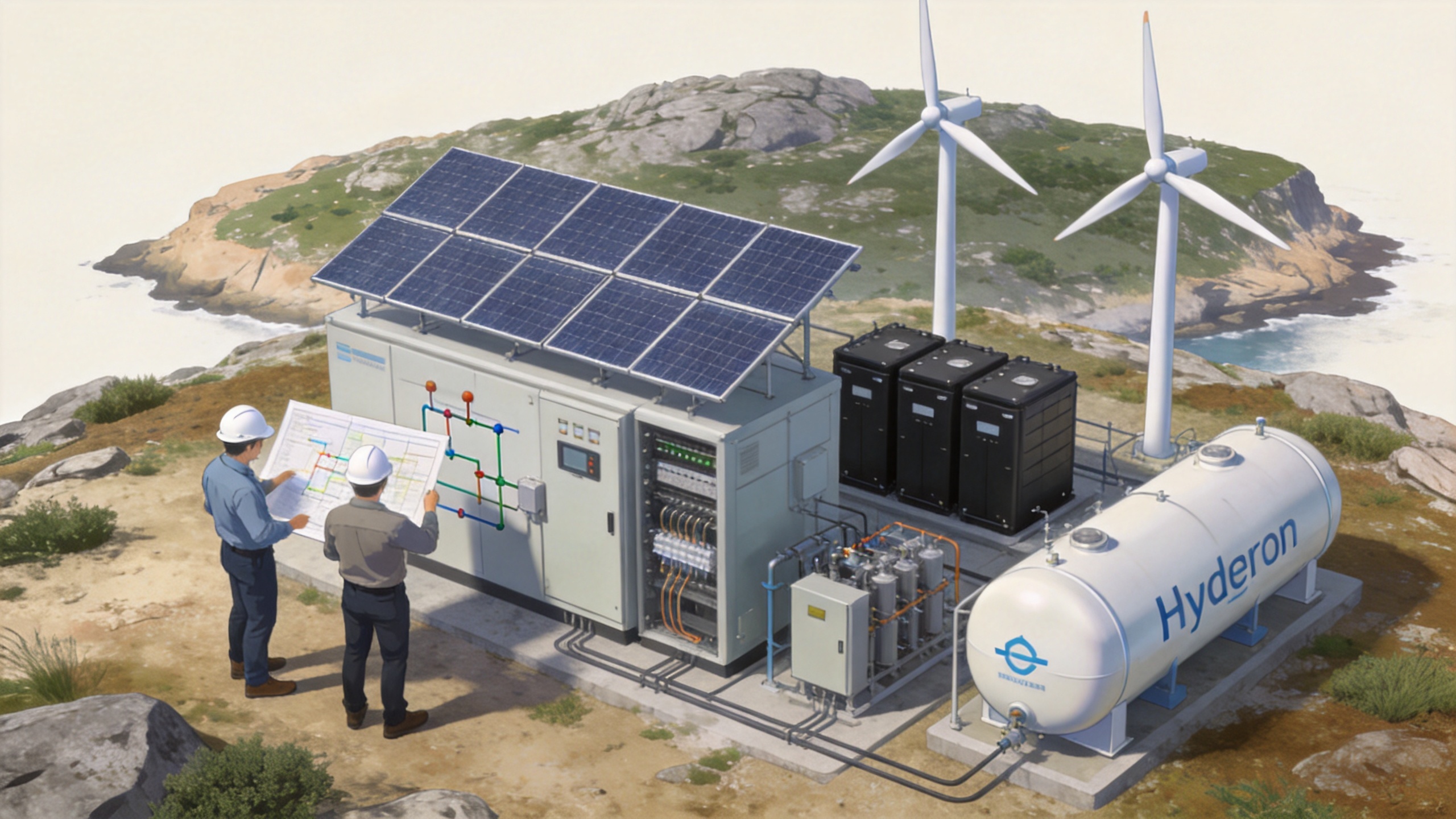
A practical LDES energy storage design often assigns different jobs to different assets. Batteries can absorb fast changes in solar or wind output, stabilize power quality, and manage routine peaks. The hydrogen chain can be reserved for longer shortages and lower-frequency events. This division avoids asking a long-duration asset to perform every rapid control task and avoids sizing batteries solely for rare, multi-day events.
That operating logic needs to be modeled at the dispatch level. Define when the battery charges and discharges, when the electrolyzer may run, what reserve must stay in hydrogen storage, and how the backup source is called. The model should apply the same reliability target and load-serving rules to every technology case. Otherwise, an LDES energy storage comparison can appear favorable simply because the scenarios were not held to the same standard.
Collect These Inputs Before Choosing a Hydrogen Path
The first deliverable should be a clean data package, not a component list. For LDES energy storage decisions, collect at least one year of interval load data where possible, then identify critical loads, expandable loads, seasonal shifts, and planned demand growth. Pair this with site-specific solar and wind resource data, existing generation performance, fuel logistics, and outage records.
Project teams should also document:
- Duration of the problem: How often do deficits exceed four, eight, ten, or twenty-four hours?
- Energy and power separately: A high instantaneous peak and a multi-day energy gap lead to different sizing decisions.
- Resource correlation: Do low-renewable periods occur at the same time as high demand?
- Site constraints: Include water quality and availability, storage footprint, transport access, safety separation, and maintenance capability.
- Economic boundary: Include replacement cycles, fuel delivery exposure, spares, staffing, permitting, and the value assigned to unserved energy.
This evidence gives LDES energy storage a measurable role. It also reveals cases where a battery-led system, a flexible load strategy, or modest renewable oversizing may address the actual constraint with less system complexity.
A Feasibility Checklist for Hydrogen Microgrids
Before moving beyond concept design, test the hydrogen pathway against five questions. First, does the renewable profile create enough surplus electricity at useful times? Second, is the expected shortage duration long enough to justify a chemical storage chain? Third, can the site operate and maintain the added equipment safely? Fourth, is the system value driven by resilience, avoided fuel logistics, hydrogen demand, or a combination of these? Fifth, does the dispatch simulation show a material improvement under the same load and reliability assumptions used for alternatives?
A project that passes this screen can progress to an integrated architecture review. For example, a hydrogen microgrid integrated solution can be evaluated as part of the system boundary, alongside renewable generation, battery storage, controls, hydrogen storage, and the site’s operating procedures. The linked solution should be assessed against the project’s validated load profile and constraints rather than selected from headline claims.
Make the Decision on Lifecycle Service, Not Equipment in Isolation
For remote systems, LDES energy storage economics are shaped by operational realities. A lower initial equipment cost may not remain lower once fuel transport, weather-related access, replacement schedules, and downtime exposure are included. Conversely, a hydrogen pathway with a higher initial scope may not be justified if surplus renewable energy is limited or long deficits are rare.
Use hourly or finer modeling, stress-test poor renewable weeks, and document the assumptions that control the outcome. Compare lifetime cost, emissions pathway, fuel dependence, reserve margin, maintainability, and the consequences of a component outage. This approach makes the hydrogen discussion concrete: it identifies whether LDES energy storage is a resilience tool for a genuine long-duration problem or an unnecessary layer in a system that needs a different intervention.
Conclusion: Treat Hydrogen as a Conditional LDES Energy Storage Option
Hydrogen can strengthen a remote microgrid where high renewable penetration, extended energy gaps, difficult fuel logistics, and resilience priorities align. It is usually most useful as part of a hybrid design in which batteries handle fast balancing and hydrogen addresses longer-duration energy needs. Start with load, resource, outage, and site data; compare options under the same assumptions; then choose the architecture that serves the required duration with an operable lifecycle plan. That is the disciplined way to evaluate LDES energy storage for remote microgrids.