
 EN

Hydrogen Microgrid vs Battery Storage: Choosing the Right Role in a Hybrid System
For a project team planning a resilient site, the question is rarely whether to use a battery or hydrogen. The practical question is how to assign short term and long term energy storage to the jobs each technology can perform without oversizing either one. In a hybrid microgrid, batteries are usually the fast electrical buffer, while hydrogen can add an energy reserve for extended shortages or infrequent high-consequence events.
This distinction affects equipment sizing, control logic, operating cost assumptions, and the conversations between an EPC, owner, and energy user. A system integrator should begin with the load profile and outage requirement rather than a preferred technology. This is also where ldes energy storage becomes relevant: duration is a planning variable, not a label to apply after equipment is selected.
Start with the service each storage layer must provide
Short term and long term energy storage should be defined by required service, response speed, and duration at the required power—not by a fixed number of hours. A useful DOE explanation defines duration as the time a fully charged system can deliver its rated power before it reaches its minimum state of charge. That definition gives teams a common way to compare scenarios, but it does not decide the architecture by itself.
| Microgrid duty | Typical storage role | Key design question |
|---|---|---|
| Fast load changes, power quality, transition support | Battery layer | How quickly must power change, and how often will the asset cycle? |
| Daily renewable shifting and peak support | Battery-led, subject to duration | What is the recurring energy gap across a normal operating day? |
| Extended renewable shortfall or multi-day resilience | Hydrogen energy layer | How much stored energy is needed after the practical battery duration is exhausted? |
| Long outage with critical-load prioritization | Coordinated battery and hydrogen dispatch | Which loads must remain online, and when should each layer begin discharging? |
The two storage layers serve complementary functions. The battery can absorb fast deviations and limit abrupt power demand on downstream equipment. The hydrogen path—electricity to electrolysis, storage, and reconversion or another approved end use—can be evaluated for longer energy gaps. Neither layer should be sized from a single average-load number.
Why batteries and hydrogen divide the work differently
Batteries generally fit tasks that reward rapid response and frequent cycling. They can help stabilize a microgrid when solar output changes, when a large motor starts, or when the site transfers between operating states. For these duties, high conversion efficiency and fast electrical response often matter more than storing energy for several days.
Hydrogen systems introduce more conversion steps and therefore require a careful whole-system efficiency assessment. Yet their value proposition changes when the project needs a large energy inventory for a long, infrequent shortage. Long-duration analysis from the U.S. Department of Energy has considered ranges from 12 hours to seven days and notes that the cost sensitivity to additional duration can differ from battery-led approaches. That does not make hydrogen a default choice; it explains why teams should separate the power rating from the energy-duration requirement.
A hybrid design can keep the battery focused on rapid dispatch while preserving hydrogen for the periods that would otherwise demand a very large battery energy capacity. The resulting short term and long term energy storage plan may reduce unnecessary cycling of the long-duration layer and avoids assuming that one asset must solve every operating condition.
Use a scenario matrix before sizing equipment
Before comparing quotations, turn the site’s operating reality into a scenario matrix. Include normal days, weak-renewable days, planned islanding, utility interruptions, seasonal production patterns, and restart conditions. For each scenario, document the critical load, required power, required duration, response time, allowed load shedding, and expected event frequency.
- Power requirement: Determine the instantaneous and sustained kW or MW that the storage system must support.
- Energy requirement: Map the kWh or MWh needed across the full event, including reserve margins defined by the project.
- Duty cycle: Separate events that occur daily from rare resilience events; they should not automatically use the same storage asset.
- Renewable and supply constraints: Check whether there is enough surplus electricity, usable operating time, water supply where relevant, and storage capacity to support the intended hydrogen pathway.
- Return-to-service plan: Model how the battery and hydrogen reserve are restored after an event, rather than considering discharge only.
This exercise often reveals a gap: a project may have ample generation on an annual basis but insufficient surplus at the particular times needed to replenish reserves. The answer may be a revised dispatch strategy, more renewable capacity, a different critical-load definition, or a different split between battery and hydrogen capacity.
Coordinate dispatch instead of treating assets as separate projects
The control philosophy is what turns two storage technologies into a hybrid microgrid. A practical hierarchy usually reserves the fastest battery response for immediate balancing and protects a defined battery state-of-charge band for transitions. The hydrogen layer can be dispatched after a duration threshold, an outage forecast, or a reserve trigger is reached. The exact logic depends on site loads, generation uncertainty, and safety procedures.
Consider a short outage during a normal operating window: the battery may carry critical loads while the controller assesses duration and renewable availability. If the event extends beyond the battery’s planned duty window, the system can move to the longer-duration strategy according to validated operating limits. This approach is more defensible than allowing all assets to discharge at once and discovering later that the reserve has been used on a brief disturbance.
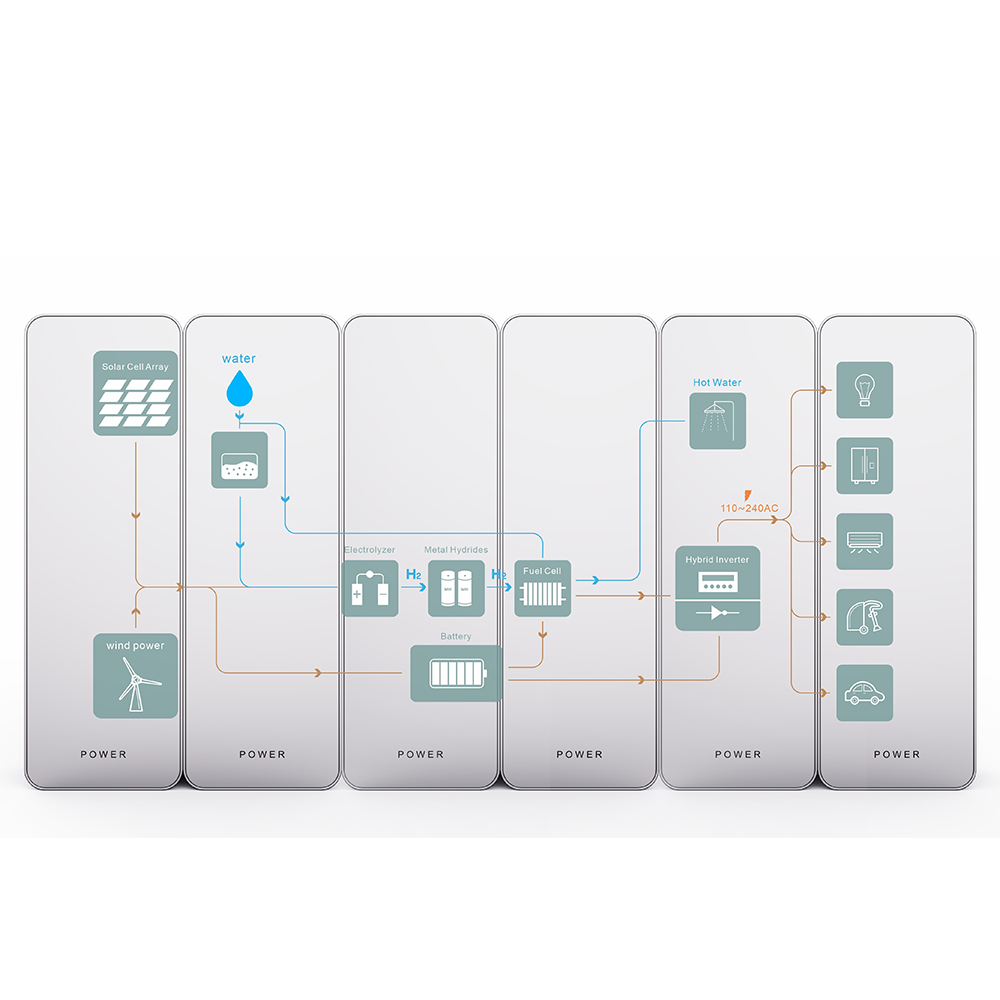
Teams evaluating a hydrogen microgrid integrated solution should ask for a clear system-boundary map: generation, conversion equipment, hydrogen storage, electrical conversion, battery system, EMS, protection, and site loads. The product link identifies an available solution category; the final capability and configuration still need project-specific confirmation.
Compare the tradeoffs that affect ownership, not just procurement
The decision should reach beyond installed cost per unit of capacity. A credible comparison addresses expected cycling, replacement planning, conversion losses, storage duration, footprint, permitting, maintenance access, safety boundaries, and operational staffing. It also tests whether the project has a valuable non-electric use for hydrogen, because that can change how the system is operated and assessed.
For ldes energy storage, longer duration should be checked against actual resilience objectives. If the requirement is only brief ride-through and routine peak management, adding a hydrogen layer may not be justified. If the requirement includes extended islanded operation after renewable variability or a multi-day interruption, a battery-only design may need a different economic and operational review. The right answer is conditional on the scenario matrix, not on a generic duration threshold.
A B2B selection checklist for hybrid microgrids
- Define critical and noncritical loads, including startup and inrush conditions.
- Specify response-time and duration targets for every resilience scenario.
- Size power and energy separately for short term and long term energy storage.
- Validate the available electricity, water, storage, and site-boundary conditions for the hydrogen path.
- Review EMS dispatch rules, reserve bands, alarms, and manual operating procedures.
- Assess lifecycle maintenance, replacement assumptions, and safe access before final procurement.
Choose roles first, then choose equipment
A hybrid microgrid works most effectively when its components have distinct responsibilities. Batteries can handle fast, repeatable electrical duties. Hydrogen can be assessed as an energy reserve when the project’s duration and resilience needs move beyond the practical role assigned to the battery. By building the operating scenarios first and then testing controls, interfaces, and lifecycle obligations, decision-makers can turn short term and long term energy storage from a broad comparison into a project-specific allocation plan.
For B2B teams, the next practical step is a technical review that links the load study to the proposed architecture, identifies assumptions that require confirmation, and clarifies how the battery and hydrogen layers will coordinate in real operation.