
 EN

Hydrogen Microgrid vs Battery Microgrid: Choosing the Right Role for Long-Duration Backup
For a project team comparing a hydrogen microgrid versus battery microgrid, the useful question is rarely “which technology wins?” It is which role each technology should perform inside a resilience plan. Batteries can respond quickly and are often well suited to short, frequent events. Hydrogen can add an energy reservoir for longer interruptions when a site has the resources and operating model to support it. The right architecture starts with the critical load, not with a technology label.
From a systems-integration perspective, the evaluation should first define the electrical boundary, the duration of the outage to be covered, and the renewable-energy pattern. A microgrid is a controlled system of generation, storage, loads, and switching—not simply a storage device. That distinction matters because power capacity and energy duration are separate design variables.
Start with the outage profile, not a storage preference
Before comparing equipment, characterize the load that must remain online. Record its steady demand, inrush or peak demand, power-quality sensitivity, daily operating hours, and the likely frequency of islanding events. A control room, communications node, refrigerated process, or remote industrial asset can have very different backup priorities even if their annual energy use looks similar.
A battery microgrid commonly fits the front end of a resilience event: fast transfer support, smoothing renewable variability, peak support, and short-duration ride-through. Its value is tied to both response speed and repeated cycling. For a site that experiences brief disruptions or must stabilize a variable load while another source starts, this can be a practical role.
A hydrogen microgrid becomes more relevant when the resilience case is measured in extended hours or days, when renewable surplus may be converted and retained for later use, or when the project needs an energy-storage path that is not limited to daily cycling alone. This is a conditional judgment. Hydrogen production, storage, conversion back to power, controls, safety systems, and site utilities all belong inside the system boundary.
Compare power and energy as separate requirements
The comparison between a hydrogen microgrid versus battery microgrid is clearer when the team separates MW or kW from MWh or kWh. Power determines how much load the system can serve at a moment in time. Energy determines how long it can sustain that service. A high-power, short-duration duty and a lower-power, multi-day duty may lead to different component choices even at the same annual energy total.
| Decision dimension | Battery-led role | Hydrogen-led role |
|---|---|---|
| Response requirement | Fast response and frequent short events | Usually paired with controls or batteries when fast transient response is required |
| Duration question | Evaluate how much additional battery capacity is needed as backup hours grow | Evaluate production, storage, and conversion capacity for extended autonomy |
| Renewable integration | Useful for smoothing and short energy shifting | Can provide a pathway to retain surplus energy for later, subject to full-system losses and resources |
| Site boundary | Focus on interconnection, enclosure, thermal management, and operations | Also include water, electricity supply, hydrogen storage route, ventilation, detection, and operating procedures |
DOE long-duration-storage discussions commonly analyze storage spans above 12 hours and out to multiple days. That is a helpful screening context, not a universal cutoff. The point is to test what happens to total project scope as the required autonomy grows. For every proposed duration, the team should model the dispatch profile rather than assume that a nameplate duration answers the resilience question.
Use a hybrid architecture when the duties are different
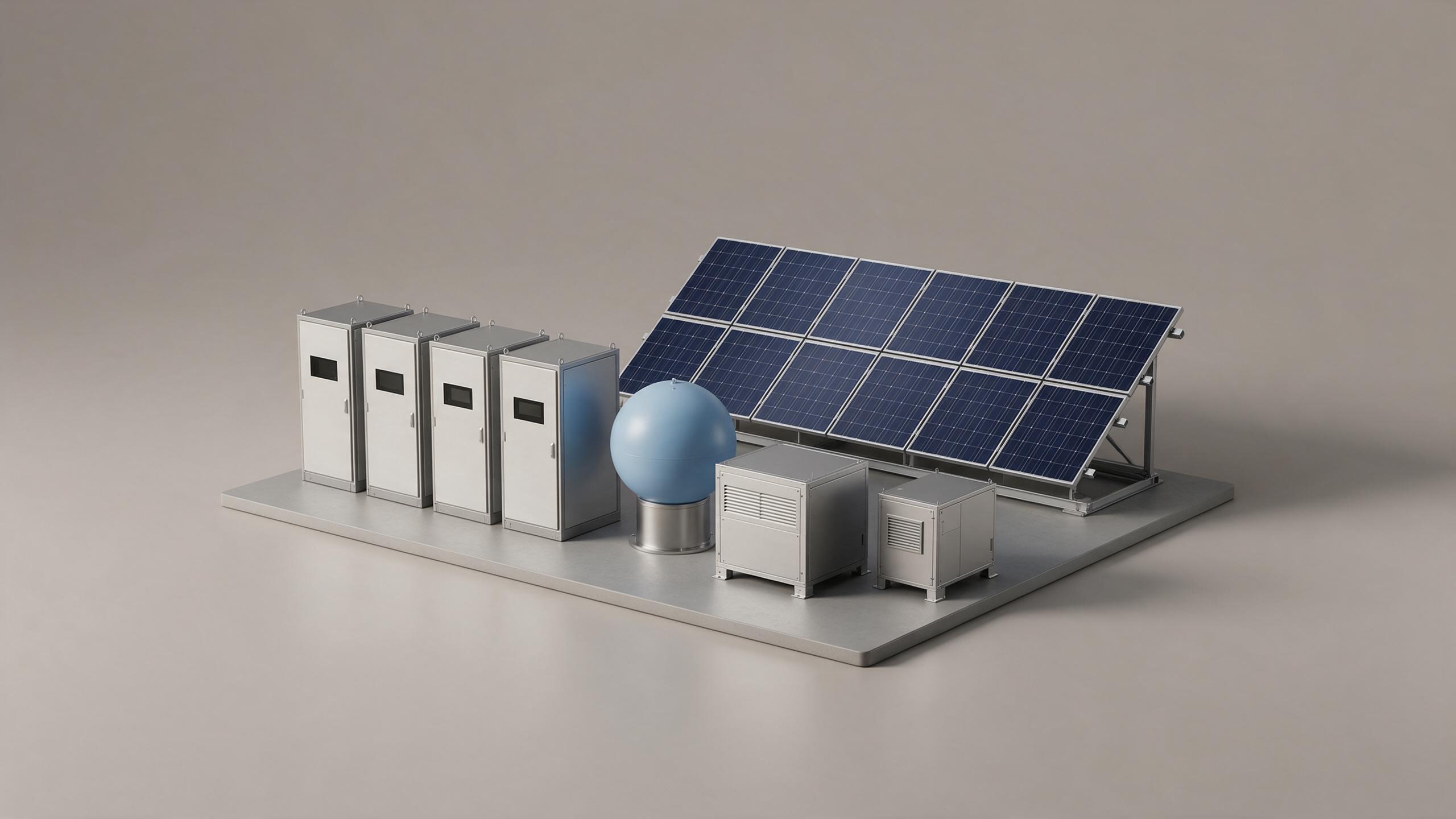
In many cases, a hybrid configuration is more useful than forcing an either-or answer. A battery can cover transfer, ramping, and short cycling; a hydrogen pathway can be assessed for the longer energy portion. The controller then needs a clear dispatch hierarchy: preserve battery state of charge for immediate events, determine when to start hydrogen conversion equipment, and define the minimum reserve for the critical load.
This approach also makes hydrogen microgrid sizing for island power more disciplined. Begin with the islanded load profile and acceptable load-shedding sequence. Then establish the required autonomy, renewable generation availability, expected periods of low resource, and the storage inventory that must remain available. Do not size hydrogen storage from average consumption alone; the longest credible low-generation interval and the critical-load priority also matter.
For teams considering a site-specific architecture, the Hydrogen microgrid integrated solution page can serve as a starting point for a system-level discussion. For the long-duration part of the assessment, the Long-term Energy Storage Programme provides a relevant internal reference. These links describe solution areas; final suitability still depends on verified site conditions and engineering review.
Check the system boundary before comparing cost
Cost comparisons often become misleading when they mix different boundaries. A battery estimate might include installed storage and power electronics, while a hydrogen estimate may omit production, compression or solid-state storage, fuel-cell or other conversion equipment, controls, safety equipment, and the work needed to integrate them. A fair comparison uses the same critical-load definition, outage duration, performance assumptions, maintenance scope, replacement assumptions, and operating responsibility.
Round-trip efficiency is important, but it is not the sole decision criterion. A battery-led approach may be attractive where frequent cycling and fast response dominate. A hydrogen-led approach may merit further analysis where duration, storage inventory, renewable-curtailment use, and multi-day resilience change the value of the system. More precisely, each claim should be tested under the site’s own load and energy-source assumptions.
Build a practical selection checklist
- Load: Which loads are critical, what are their start-up peaks, and what can be shed?
- Duration: Is the target measured in minutes, several hours, or multiple days?
- Renewables: How much surplus generation is expected, and when is it available?
- Site resources: Are electricity, water, space, storage arrangements, ventilation, and access compatible with the intended hydrogen boundary?
- Operations: Who will monitor the system, perform inspections, manage inventory, and respond to alarms?
- Economics: Have both options been calculated with consistent assumptions and the same service level?
Questions to use in a design workshop
A structured workshop can make a hydrogen microgrid versus battery microgrid comparison more useful than a generic ranking. Convert operating assumptions into design inputs before comparing costs.
- What critical kW must remain available in the first second, and what load peaks must the system carry?
- For a hydrogen microgrid versus battery microgrid decision, what energy inventory is needed for the longest credible outage?
- Which loads can be sequenced or shed, and which transfer-time or power-quality requirements are non-negotiable?
- How often will short cycling occur during normal operation, and how much renewable surplus has been measured?
- Does the site have defined electricity, water, space, ventilation, storage, and operational boundaries for a hydrogen pathway?
- For hydrogen microgrid sizing for island power, what low-resource interval, reserve margin, and dispatch sequence must the model test?
- Who will monitor alarms, maintain equipment, manage inventory, and rehearse islanding and restart procedures?
- Does the financial model compare both options at the same critical-load service level and outage duration?
These answers give a hydrogen microgrid versus battery microgrid assessment a traceable basis and clarify whether detailed engineering should proceed.
Choose roles, then validate the design
The durable conclusion in a hydrogen microgrid versus battery microgrid assessment is not that one technology replaces the other. Batteries often address fast and short-duration electrical duties; hydrogen can be evaluated for longer-duration energy and resilience duties where its broader system boundary is feasible. The appropriate split follows the load profile, outage duration, renewable-resource pattern, and site-readiness evidence.
Start by collecting interval load data, the critical-load hierarchy, renewable-generation history, and outage scenarios. With these inputs, project teams can compare options on a common basis and decide whether a battery-led, hydrogen-led, or hybrid microgrid should move into detailed engineering.