
 EN

Hydrogen Microgrid Planning: Assessing Storage Duration for Remote Power
Remote power projects do not need a generic storage number; they need an energy storage duration that protects the loads that matter when solar, wind, fuel delivery, or grid access is uncertain. From a hydrogen technical-advisor perspective, the first task is to match the operating boundary before comparing equipment. That means separating peak power, daily energy, critical loads, renewable variability, and the period in which the site must operate without resupply.
For a hydrogen microgrid, energy storage duration describes how long the system can deliver a stated electrical output before the available stored energy is depleted. It is not simply the size of a hydrogen vessel, and it is not the same as the duration shown for a battery. A credible plan connects the duration target to a dispatch model that includes electrolyzer operation, storage conditions, fuel-cell output, balance-of-plant loads, and usable reserves.
Start With the Service You Must Maintain
Begin with a load hierarchy. List life-safety, communications, water treatment, process controls, refrigeration, and other critical circuits separately from discretionary demand. Then establish the required load profile in hourly intervals. The initial energy storage duration is the time required to sustain this critical-load profile during the design outage, not the time required to run every connected asset at once.
A simple screening calculation is:
Required usable electrical energy (kWh) = critical load (kW) × autonomy hours
For variable loads, calculate each hourly block and add the results. Next, apply modeled conversion and reserve factors rather than assuming each kilowatt-hour of renewable generation becomes a delivered kilowatt-hour. This turns the energy storage duration discussion from a nameplate comparison into a resilience requirement.
Choose the Design Outage Before Choosing a Technology
Design outage is a commercial and operational choice. A telecommunications relay site may need a different energy storage duration from an isolated industrial facility with a maintained generator connection. Review the longest credible periods of low renewable output, repair access constraints, fuel logistics, seasonal weather patterns, and the site owner’s tolerance for curtailment.
Long-duration energy storage, or ldes energy storage, is commonly discussed for multi-hour to multi-day needs. U.S. Department of Energy material describing hydrogen and fuel-cell storage analyses spans roughly 12 hours to 7 days; its 120-hour example means five days of discharge at the specified full output. That illustration is useful for scale, but it is not a universal sizing rule. The appropriate energy storage duration remains site-specific.
Model Renewable Variability and Recharge Windows
A remote microgrid must recover its inventory after an outage event. Therefore, assess the energy available for both critical loads and recharge during ordinary operation. Use at least one representative high-resource period and one difficult weather sequence. If the renewable resource repeatedly serves the load but cannot rebuild reserves, the chosen energy storage duration may look adequate in a single outage simulation while leaving the site exposed after consecutive events.
Hydrogen can be relevant where the target energy storage duration extends beyond a short daily cycle, because stored hydrogen can separate energy production from energy use. However, the round-trip pathway matters. Electricity used for production, compression or conditioning, storage, and reconversion must be represented in the model. DOE discussion of hydrogen long-duration systems highlights that round-trip efficiency changes the electricity needed to supply delivered output. This is why engineers should validate annual energy balance as well as autonomy hours.
Translate Electrical Autonomy Into Hydrogen Inventory
After the electrical model is stable, convert usable electrical energy into hydrogen inventory using the confirmed fuel-cell efficiency, auxiliary consumption, minimum operating reserve, and storage-system conditions. Do not use a single generic kilogram-per-kilowatt-hour factor without verifying the equipment boundary. The resulting inventory should support the required energy storage duration at the selected dispatch power, with a documented reserve policy.
It also helps to keep four quantities distinct:
- Power rating: the kW available to meet an instantaneous or sustained load.
- Usable energy: the electrical kWh available after operating limits and reserves.
- Energy storage duration: usable energy divided by the defined discharge power or load profile.
- Hydrogen inventory: the stored fuel required to produce that usable energy under confirmed conditions.
This distinction prevents a common error: increasing hydrogen inventory without checking whether the fuel cell, inverter, or distribution equipment can deliver the necessary peak power.
Use a Hybrid Architecture Where Duty Cycles Differ
Many remote projects have fast load steps and long low-resource intervals. In that case, a battery may handle short transients and frequent cycling, while hydrogen provides the longer energy storage duration required for extended autonomy. The split should be decided by load behavior, renewable profile, maintenance access, and lifecycle assumptions—not by a fixed duration threshold.
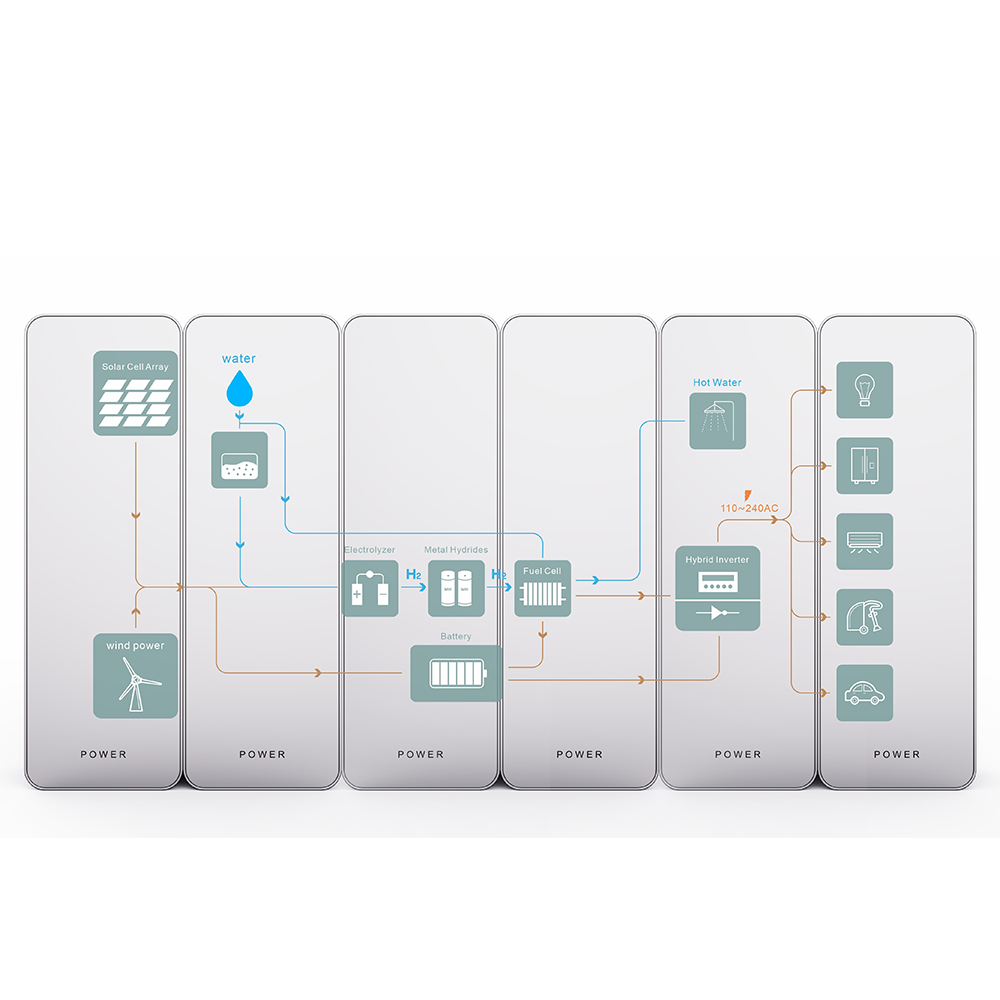
For teams evaluating system interfaces, the Hydrogen microgrid integrated solution can serve as a discussion point for mapping power conversion, hydrogen production, storage, and dispatch boundaries. Project-specific configuration and performance assumptions still need to be confirmed during engineering review.
A Practical Data Checklist for Storage-Duration Sizing
Before approving a target energy storage duration, collect these inputs:
- Interval load data and a clearly defined critical-load list.
- At least one full year of renewable-resource data, plus adverse weather scenarios.
- Permitted curtailment, recovery-time, and reserve requirements.
- Fuel-cell efficiency curves, auxiliary loads, start-up constraints, and minimum stable output.
- Electrolyzer production assumptions, water availability, and available recharge power.
- Storage conditions, delivery or resupply options, maintenance access, and safety requirements.
First clarify the application boundary, then test the operating trade-offs. If these inputs are incomplete, a proposed energy storage duration should be treated as a planning range rather than a final design commitment.
Move From a Duration Target to an Operable Plan
The useful question is not “How many hours of storage should we buy?” It is “What energy storage duration keeps this critical load operating through the defined outage and can be restored under expected resource conditions?” Answering it requires a transparent simulation, clear reserve rules, and verification of every system connection.
For remote power planners, hydrogen can extend the options for ldes energy storage when the resilience window reaches beyond short cycling needs. A sound microgrid plan will document the critical load, chosen outage, conversion losses, recharge window, hydrogen inventory, and acceptance tests together. That creates a defensible energy storage duration target—and a clearer basis for comparing architectures.