 EN
EN

Hydrogen Manufacturing Units: How to Plan an Industrial Deployment
Industrial hydrogen gas production is not a single equipment purchase. It is a site-and-system decision that connects power, water, controls, compression, storage, safety, and offtake. For a project team, the most reliable way to plan hydrogen gas production is to define the operating duty first, then size the electrolyzer package and balance of plant around it.
This article focuses on industrial water-electrolysis projects. It is intended for B2B buyers comparing electrolyzer technology options and preparing a vendor-ready deployment brief.
Start with the hydrogen demand, not the nameplate rating
A useful hydrogen gas production plan starts with the customer’s hourly, daily, and seasonal demand profile. Ask how the gas will be used, what purity and delivery pressure are required, how many operating hours are expected, and what flexibility the downstream process can accept. These answers shape the required production rate more clearly than a headline MW rating alone.
Build a design basis with three cases: minimum stable demand, normal operating demand, and peak demand. Then decide whether the plant will follow load, operate steadily with buffer storage, or combine both. This approach prevents a hydrogen gas production unit from being oversized for rare peaks or undersized for routine delivery.
Choose electrolyzer technology through operating constraints
Electrolyzer technology should be assessed against power availability, ramping needs, water-treatment capability, maintenance strategy, footprint, and integration requirements. Rather than treating one technology as universally suitable, compare the proposed solution against the actual duty cycle and site interfaces.
| Planning question | Why it matters | Vendor input to request |
|---|---|---|
| How variable is the power supply? | It affects operating strategy and control design. | Turndown range, ramping behavior, and power-quality limits. |
| What gas conditions are needed? | Purity, pressure, and moisture requirements determine downstream equipment. | Specified outlet conditions and any required purification or compression scope. |
| What water is available? | Water quality and treatment change the utility and maintenance design. | Feed-water quality specification, consumption assumptions, and treatment boundaries. |
| What is included in the package? | Scope gaps often appear at interfaces. | Battery limits, P&IDs, electrical single-line diagram, and control-interface list. |
For context, a UNECE search result cites indicative process-level water use of 11–15 kg of water per kg of hydrogen for alkaline and AEM electrolysis. Treat this as a feasibility-screening input, not a site guarantee: pretreatment, cooling, reject streams, and local water quality must be confirmed for each hydrogen gas production project.
Map utilities and balance of plant early
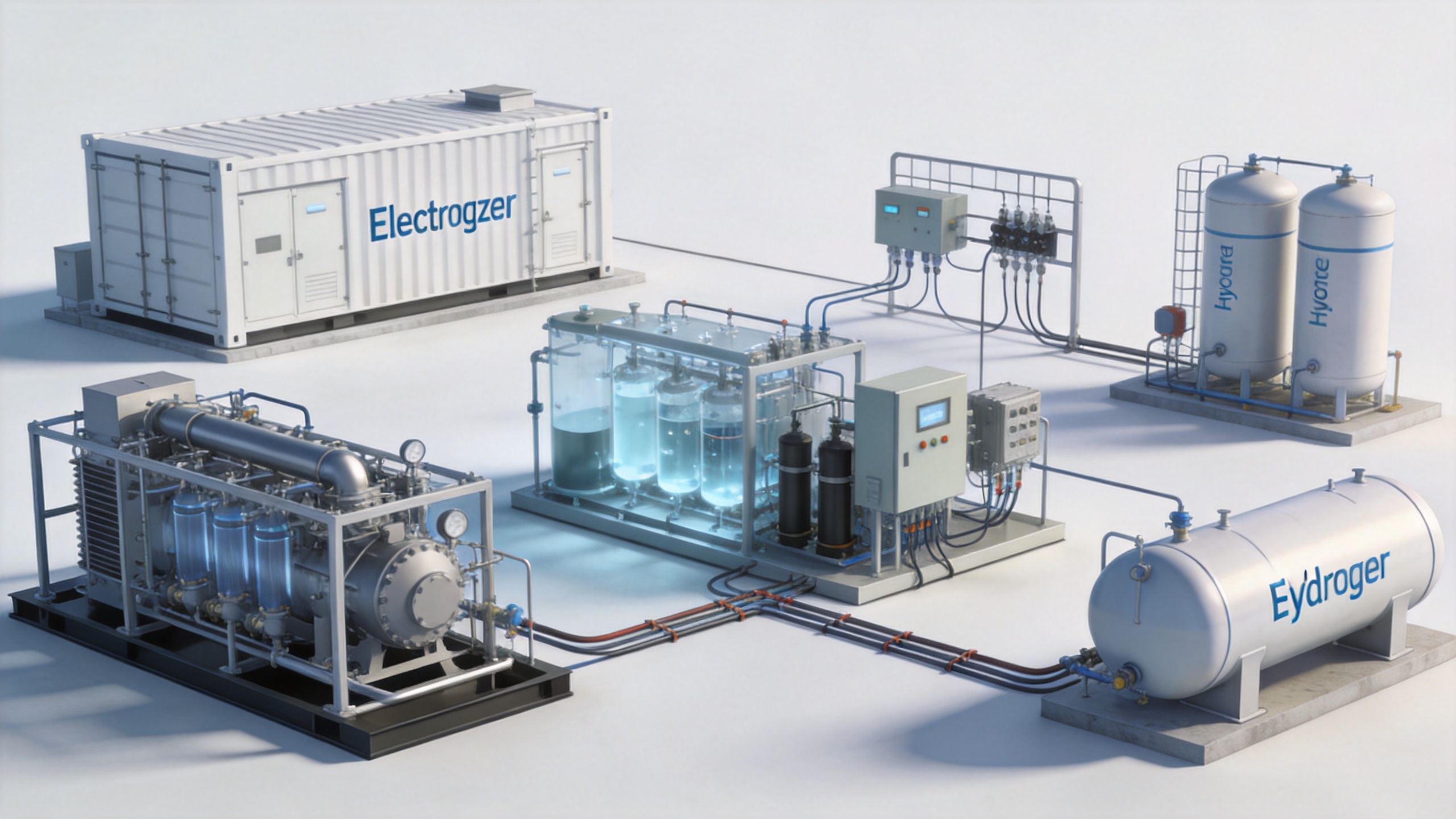
The electrolyzer stack is only one part of hydrogen gas production. A deployment plan should map the full chain: incoming electrical connection, transformer and rectifier scope, water source and treatment, cooling, hydrogen drying or purification where required, compression, storage, dispensing or pipeline interface, oxygen handling, ventilation, drainage, and controls.
Use a responsibility matrix to show who supplies, installs, commissions, and accepts each interface. It should cover civil works, cable routes, pipe racks, foundations, hazardous-area requirements, communications, emergency shutdown, and fire-and-gas integration. This is often the difference between a quoted unit and a workable hydrogen gas production facility.
Plan the footprint around access and safe operation
Reserve space for maintenance access, lifting paths, water-treatment skids, electrical cabinets, compressors, storage, vent routing, and future expansion. Do not use only the footprint shown on a product brochure. The practical footprint for hydrogen gas production includes inspection clearances and the separation needed for safe operation and emergency response.
For scalable project comparisons, review the available 100KW-500KW hydrogen production unit and 1MW-5MW hydrogen production unit as size-band references. Confirm the final equipment scope, configuration, and site interfaces directly with the supplier before design freeze.
Turn safety and compliance into a design input
Safety cannot be added after the equipment layout is fixed. The project team should involve process safety, electrical, civil, and operations stakeholders during early hydrogen gas production planning. Confirm applicable local codes, permitting requirements, hazardous-area classification, ventilation, detection, venting, shutdown philosophy, and emergency procedures.
ISO 22734 is a relevant reference for hydrogen generators using water electrolysis and addresses construction, safety, and performance requirements for packaged or factory-matched systems. It does not replace local project obligations. Ask vendors to state the applicable standard edition, exclusions, test evidence, and the division of responsibility for site-level compliance.
Create a vendor-ready request package
A strong request-for-quotation package makes hydrogen gas production proposals easier to compare. Include the demand profile, target gas conditions, electricity characteristics, water analysis, ambient conditions, plot plan, delivery milestone, controls preference, documentation requirements, commissioning expectations, and acceptance-test criteria.
- Required hydrogen flow, pressure, purity, and operating profile
- Available power capacity, voltage, quality, and renewable-generation profile
- Water source, analysis, treatment constraints, and discharge conditions
- Required package boundaries and balance-of-plant responsibilities
- Site layout, access, climate, seismic, and installation constraints
- Safety, permitting, documentation, training, and after-sales expectations
Request stated values and assumptions in a single comparison sheet. That creates a traceable basis for selecting electrolyzer technology, evaluating lifecycle operating needs, and identifying scope gaps before purchase order release.
Use staged decisions to reduce deployment risk
Industrial hydrogen gas production is easier to control when decisions are staged: feasibility and design basis; utility and site validation; supplier technical alignment; detailed engineering; factory acceptance; installation; commissioning; and performance acceptance. At each gate, document what has been verified and what remains conditional.
The outcome should be more than an electrolyzer selection. A complete plan connects the production package to the real operating environment, gives every interface an owner, and leaves the project team with measurable acceptance criteria. That is how hydrogen gas production moves from a promising concept to an industrial deployment that can be built, operated, and expanded with confidence.