
 EN
EN

Hydrogen Energy Storage for Remote and Island Microgrids
Remote communities and island operators face a different planning problem from a grid-connected site: power must remain available when fuel deliveries are delayed, weather changes quickly, and the nearest utility connection is impractical. Green hydrogen energy storage gives planners a way to convert surplus renewable electricity into a transportable, dispatchable energy reserve. It is not a replacement for every battery. In a well-designed hydrogen microgrid system, it is usually the long-duration layer that works alongside batteries, renewable generation, controls, and critical-load priorities.
For B2B teams evaluating a new microgrid, the useful question is not simply whether hydrogen is “better” than batteries. The question is which duty each asset should perform, how long the site must operate through low-renewable periods, and what operating constraints shape the design. This article outlines a practical evaluation path for green hydrogen energy storage in remote and island applications.
Why remote and island microgrids need a long-duration layer
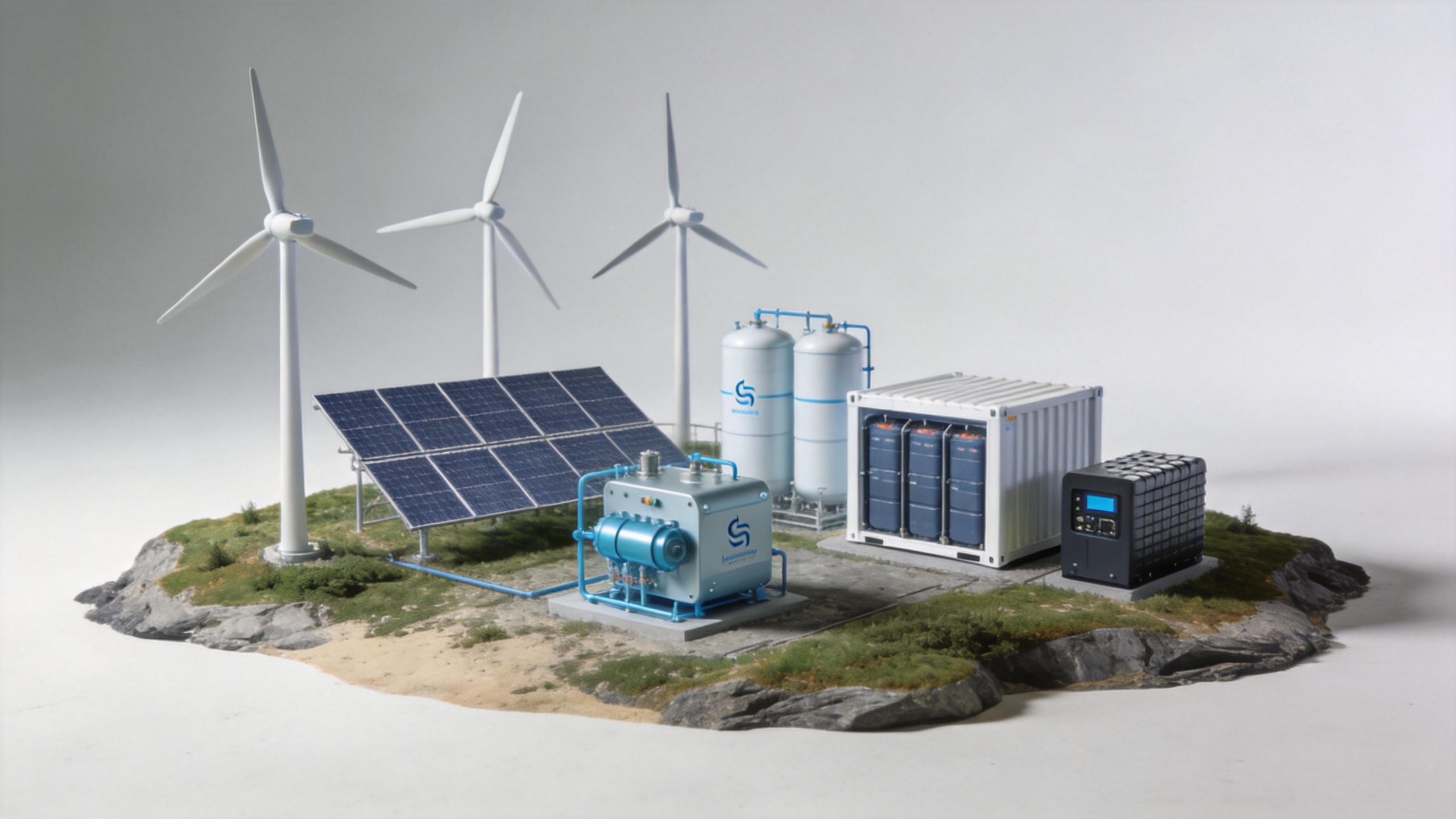
Solar and wind can reduce imported-fuel dependence, but their output can diverge from the load profile. A short renewable dip may be handled efficiently by a battery. A multi-day weather event, seasonal mismatch, or logistics disruption is a different problem. Green hydrogen energy storage can absorb renewable surplus through electrolysis, retain that energy as hydrogen, and return electricity through a fuel cell or another approved conversion path when the microgrid needs sustained support.
This makes the technology relevant where resilience and autonomy matter as much as daily energy shifting. Hybrid hydrogen-battery studies for island microgrids commonly examine how the two technologies address imbalances across different time horizons. The operational principle is straightforward: use fast-response assets for fast events, then reserve hydrogen inventory for longer gaps and planned resilience coverage.
Separate the roles of batteries and green hydrogen energy storage
| Microgrid duty | Typical fit | Planning question |
|---|---|---|
| Second-to-second frequency support | Battery and controls | How quickly must the system respond to a load step? |
| Hourly solar shifting | Battery, sometimes hydrogen | What is the daily renewable surplus and evening peak? |
| Multi-day reserve | Green hydrogen energy storage | How many low-generation days must critical loads survive? |
| Seasonal or logistics reserve | Green hydrogen energy storage | Can renewable surplus be retained for a long operating window? |
This division of work prevents a common sizing mistake: forcing one technology to cover every time scale. Batteries may reduce cycling stress on the hydrogen system, while green hydrogen energy storage can reduce the need to oversize battery energy capacity for rare but consequential long-duration events. Final dispatch logic should be modeled with site load data, renewable-resource data, operating rules, and an agreed definition of critical load.
Match the hydrogen storage path to the site
The storage choice affects footprint, delivery strategy, safety design, maintenance, and operating flexibility. Compressed gas, metal hydride storage, and other storage paths each create different integration conditions. For context, the U.S. Department of Energy notes that gaseous hydrogen storage commonly uses high-pressure tanks in the 350–700 bar range; that range is not a universal specification. Project teams must select pressure, equipment layout, and protective measures for the actual site, local codes, transport route, and maintenance capability.
For a remote island, the decision should start with constraints rather than a preferred hardware format. Consider available land, corrosion exposure, water supply, vessel access, technician availability, and whether hydrogen will be produced continuously or in defined renewable-surplus windows. A green hydrogen energy storage concept is credible only when its electrolyzer, storage, reconversion equipment, controls, and balance-of-plant provisions are assessed as one operating system.
Design around renewable surplus, water, and critical loads
Start with measured or modeled hourly data. Estimate when renewable generation exceeds demand, how often the site enters a deficit, and which loads are essential. Then test several operating cases instead of a single annual average:
- Normal renewable day: batteries manage short fluctuations; the electrolyzer uses qualified surplus when available.
- Extended low-resource period: battery dispatch is protected for fast stability needs while green hydrogen energy storage supports defined critical loads.
- Fuel-delivery interruption: reserve policy and load-shedding logic determine how long the site can operate independently.
- Maintenance condition: the design must retain a safe, understandable operating mode when one conversion asset is offline.
Water treatment and quality should be treated as a core design input for on-site electrolysis, not a late-stage utility detail. Similarly, heat rejection, ventilation, fire protection, gas detection, electrical isolation, and emergency procedures should enter the concept phase. These factors are especially important where the site has a small operations team or difficult access.
Use a practical procurement checklist
At the consideration stage, compare proposals against the same evidence set. Ask suppliers to explain the duty split between the battery and green hydrogen energy storage, show the assumed renewable and load profiles, identify the critical-load autonomy target, and describe maintenance intervals and spare-parts strategy. Require a clear interface map for generation, electrolyzer, storage, fuel cell, battery, microgrid controller, protection system, and remote monitoring.
It is also worth confirming which assumptions remain site-dependent. Equipment performance, runtime, hydrogen inventory, and lifecycle cost cannot be inferred from a product title or a generic diagram. A credible proposal should expose its assumptions and show how changes in wind, solar, demand growth, or logistics affect the design.
Move from concept to an integrated microgrid plan
For organizations exploring a coordinated architecture, Hyto Energy provides a hydrogen microgrid integrated solution as a starting point for system-level discussions. The right next step is a site-specific assessment of energy resources, loads, storage conditions, operating responsibilities, and applicable requirements—not a one-size-fits-all capacity claim.
When designed around those inputs, green hydrogen energy storage can give a remote or island microgrid a valuable long-duration resilience layer. Pair it with appropriate fast-response storage, transparent control logic, and a realistic operations plan to create a system that is easier to evaluate, procure, and operate over time.