
 EN
EN

Hydrogen Energy Storage for Long-Duration Renewable Energy Flexibility
Wind and solar output can arrive at a different time from when a site needs energy. A hydrogen energy storage system gives developers another way to manage that mismatch: use surplus renewable electricity to make hydrogen, hold the energy for a longer interval, and use it later when the system needs power, heat, fuel, or grid support. For renewable projects with daily, multi-day, or seasonal variability, the central question is not simply “how much energy can be stored?” It is whether the storage pathway can match the timing and operating profile of the asset.
This makes hydrogen especially relevant to renewable energy storage plans where a short-duration battery alone may not cover the full flexibility requirement. It is not a universal replacement for batteries. Instead, a hydrogen energy storage system can complement fast-response storage by serving a different part of the duration spectrum.
Why renewable systems need long-duration flexibility
Renewable generation is variable by design. Solar output follows daylight and weather patterns; wind output can change across hours, days, and seasons. Curtailment can occur when generation is abundant but demand, transmission capacity, or local consumption is limited. At other times, the same site may need firm energy while renewable production is low.
The U.S. Department of Energy describes long-duration energy storage as systems capable of delivering electricity for ten hours or more. That definition is useful because it shifts attention from a single power rating to the relationship between stored energy and the time it can be delivered. A hydrogen energy storage system is designed around this longer timing problem: electricity feeds an electrolyser, hydrogen is stored, and an end-use device converts or consumes the hydrogen when the project needs it.
For project teams, the practical opportunity is to turn otherwise constrained renewable output into a dispatchable energy carrier. The practical challenge is to design the full chain rather than evaluating one component in isolation.
How a hydrogen energy storage system works
A typical hydrogen energy storage system has four connected functions:
- Convert: renewable electricity powers electrolysis to produce hydrogen.
- Store: hydrogen is held in a storage medium selected for the site, duration target, safety requirements, and operating conditions.
- Dispatch: controls decide when it is better to store energy, preserve inventory, supply a load, or provide support to a microgrid.
- Use: hydrogen can be directed to a fuel cell, turbine, industrial process, or other approved end-use pathway.
This chain explains why system integration matters. The electrolyser sizing affects how much renewable surplus can be captured. Storage capacity affects how long the site can bridge low-generation periods. The conversion and end-use equipment determine the delivery profile. Controls coordinate all three against renewable forecasts, load priorities, and operating constraints.
Where hydrogen fits beside batteries
Batteries are often a strong option for short, frequent charge-discharge cycles and rapid response. A hydrogen energy storage system becomes more relevant when the design case includes extended energy shifting, infrequent but longer backup windows, or the need to use hydrogen beyond electricity generation. The two technologies can therefore be complementary rather than competing choices.
| Planning question | Why it matters |
|---|---|
| How long is the energy gap? | It distinguishes intraday balancing from multi-day or seasonal flexibility. |
| What is the delivery need? | Power quality, backup duration, heat, fuel, and grid support create different system requirements. |
| How often will storage cycle? | Usage frequency influences the operating strategy and economics of renewable energy storage. |
| What infrastructure is available? | Space, water, electrical interconnection, safety zoning, and logistics shape feasible storage pathways. |
These questions prevent a common mistake: comparing technologies only on round-trip efficiency. Efficiency is important, but duration, energy volume, controllability, safety design, and the value of multiple end uses also matter.
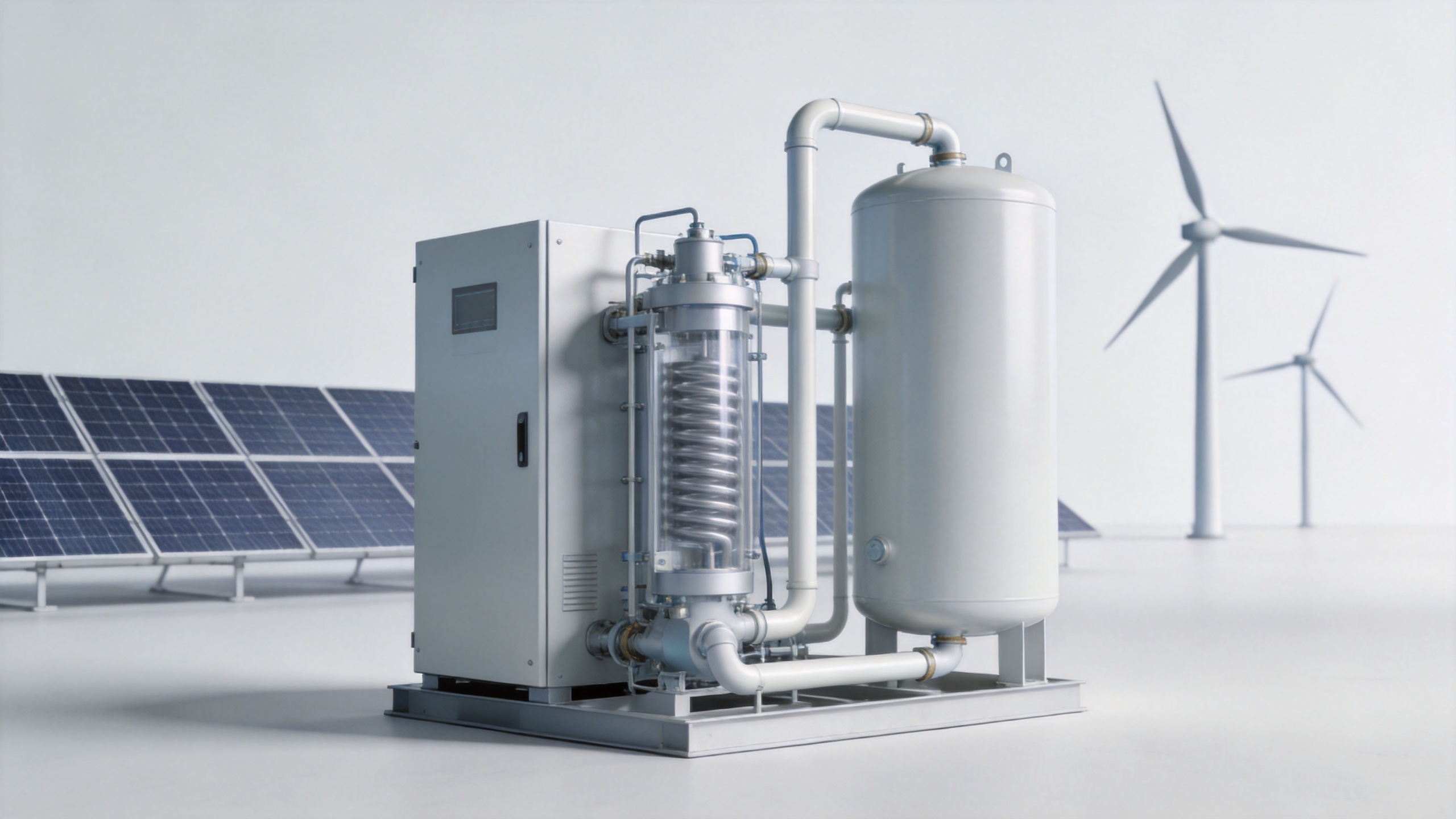
From surplus power to seasonal options
Hydrogen offers a way to separate when energy is produced from when it is needed. That separation can be valuable for remote sites, industrial campuses, renewable hubs, and microgrids that experience recurring periods of surplus and deficit. The system does not make variability disappear; it creates an operational option for moving energy across time.
Demonstrations are advancing across several storage approaches. The International Energy Agency’s Global Hydrogen Review 2025 describes a HYBRIT project in Sweden that demonstrated hydrogen storage in a 100 m³ lined hard-rock cavern at roughly 70 MWh. It also reports an Austrian field test that stored 3.3 GWh of hydrogen in a depleted porous sandstone reservoir with 98% purity recovery. These examples are not universal performance benchmarks, but they illustrate the scale and geological pathways being evaluated for longer-duration storage.
For above-ground and distributed applications, the appropriate hydrogen storage system will depend on the required capacity, site footprint, operating pressure, thermal management, delivery profile, and applicable codes. Engineering teams should define these conditions before selecting a storage route.
Designing renewable energy storage around real operating data
An effective design begins with time-series evidence, not a generic equipment list. Start by mapping renewable generation, critical loads, curtailment intervals, seasonal patterns, and planned expansion. Then test system configurations against those conditions.
- Measure how often surplus renewable electricity is available and how long it lasts.
- Separate essential loads from flexible loads so dispatch priorities are clear.
- Set a storage-duration target for normal operation and a separate target for resilience events.
- Review the electrical, water, ventilation, safety, and control interfaces as one system.
- Define how hydrogen inventory will be monitored, protected, and replenished.
For projects that need an integrated starting point, Hyto Energy’s Hydrogen microgrid integrated solution can be reviewed as a site-level solution reference. Where storage capacity is the focus, the Mega hydrogen storage unit provides a related product reference for discussions about hydrogen inventory and system integration. Final selection should follow project-specific engineering and safety review.
What to evaluate before moving forward
A hydrogen energy storage system should be evaluated as part of a renewable-energy operating model. Teams should verify the renewable resource profile, load forecast, system boundaries, permitting path, storage conditions, maintenance approach, and the intended use of the hydrogen. They should also test scenarios such as prolonged low renewable output, changes in demand, expansion of generation capacity, and a loss of grid connection.
For an awareness-stage project, the goal is not to promise a single answer. It is to identify when hydrogen creates meaningful long-duration flexibility and what information is needed to assess feasibility. With a clear load profile and integrated design basis, hydrogen can become a useful layer in a broader renewable energy storage strategy—one that captures surplus energy today and preserves options for tomorrow.