
 EN

How to Size an Industrial Hydrogen Generator for Your Production Target
Choosing an industrial hydrogen generator starts with the production target, not with a nameplate rating. A buyer may know the daily hydrogen requirement, yet the correct equipment capacity also depends on when that gas is needed, whether renewable power is intermittent, what pressure is required downstream, and how much buffer storage the site can support. For B2B projects, the useful question is not “Which unit is biggest?” but “What production, storage, and operating profile will reliably serve the process?”
This decision guide follows that system boundary. It is intended for buyers evaluating water-electrolysis systems for industrial hydrogen supply, energy storage, or microgrid integration. Final engineering selection should still be based on site data, applicable codes, and supplier documentation.
Start with the hydrogen production target
First, define the demand in a consistent unit: kilograms per day, normal cubic metres per hour (Nm³/h), or a batch-by-batch consumption schedule. Then separate average demand from peak demand. A facility needing 100 kg per day evenly across 24 hours has a very different production profile from a facility that consumes the same quantity in two short shifts.
For an industrial hydrogen generator, a simple early-stage calculation is:
Required average production rate = daily hydrogen demand ÷ planned production hours.
For example, if a site needs 100 kg/day and plans to run electrolysis for 20 hours/day, the average required output is 5 kg/h before allowing for operating margin, planned maintenance, storage losses, and delivery conditions. Do not treat this estimate as a final equipment specification. It is the starting point for a load profile discussion.
Here is an easy-to-miss point: a larger unit is not automatically the better choice. Oversizing can create low-load operation, unused electrical infrastructure, and capital tied up in capacity that the site rarely needs. Undersizing can force frequent storage drawdown or restrict expansion. The right industrial hydrogen generator is the one whose usable output matches the defined operating window.
Translate operating hours into electrolyzer capacity
Once demand is clear, map it against the hours during which the system can run. Sites supplied by stable grid power may design around a long daily operating window. Projects coupled with solar, wind, or constrained power availability may need a shorter window and therefore a higher instantaneous production rate or more storage.
Electricity planning belongs in the same calculation. Commercial electrolysis is often discussed in the range of roughly 50–55 kWh per kilogram of hydrogen, but actual consumption depends on the technology, balance-of-plant equipment, water treatment, compression boundary, inlet conditions, and operating point. Use a project-specific energy model before committing to transformer, cable, and interconnection capacity.
| Planning input | Why it changes capacity selection | Question to confirm |
|---|---|---|
| Daily hydrogen demand | Sets the base production requirement | How many kg/day or Nm³/day are required? |
| Operating window | Converts daily demand into hourly output | Can the system run 24/7, or only during selected hours? |
| Peak consumption | Determines buffer storage and delivery rate | Are there shift changes, batch events, or fueling peaks? |
| Available electric power | Limits practical electrolyzer rating | What power is firm, curtailed, or variable? |
| Expansion plan | Shapes modularity and plot-space decisions | What demand could exist in the next phase? |
Separate production capacity from hydrogen storage
Production capacity and storage serve different jobs. The industrial hydrogen generator converts electricity and water into hydrogen; storage absorbs timing differences between generation and use. When demand is variable, adding appropriately designed storage may be more practical than sizing the generator to every short peak. When power is intermittent, storage can also help retain production made during available power periods for later use.
This is where metal hydride hydrogen storage may enter an early system discussion. Its suitability depends on the required pressure, temperature management, cycle pattern, footprint, response expectations, and the wider process design. It should not be treated as a universal substitute for every storage route. Assess the storage path alongside compression, purification, dispensing or process-delivery requirements.
For buyers who need a medium-scale project discussion, Hyto’s 100KW-500KW range provides a relevant starting point for comparing system scope. Larger production targets can be reviewed against the available 1MW-5MW range. These links identify available capacity ranges; final output, utilities, and configuration should be confirmed for the project.
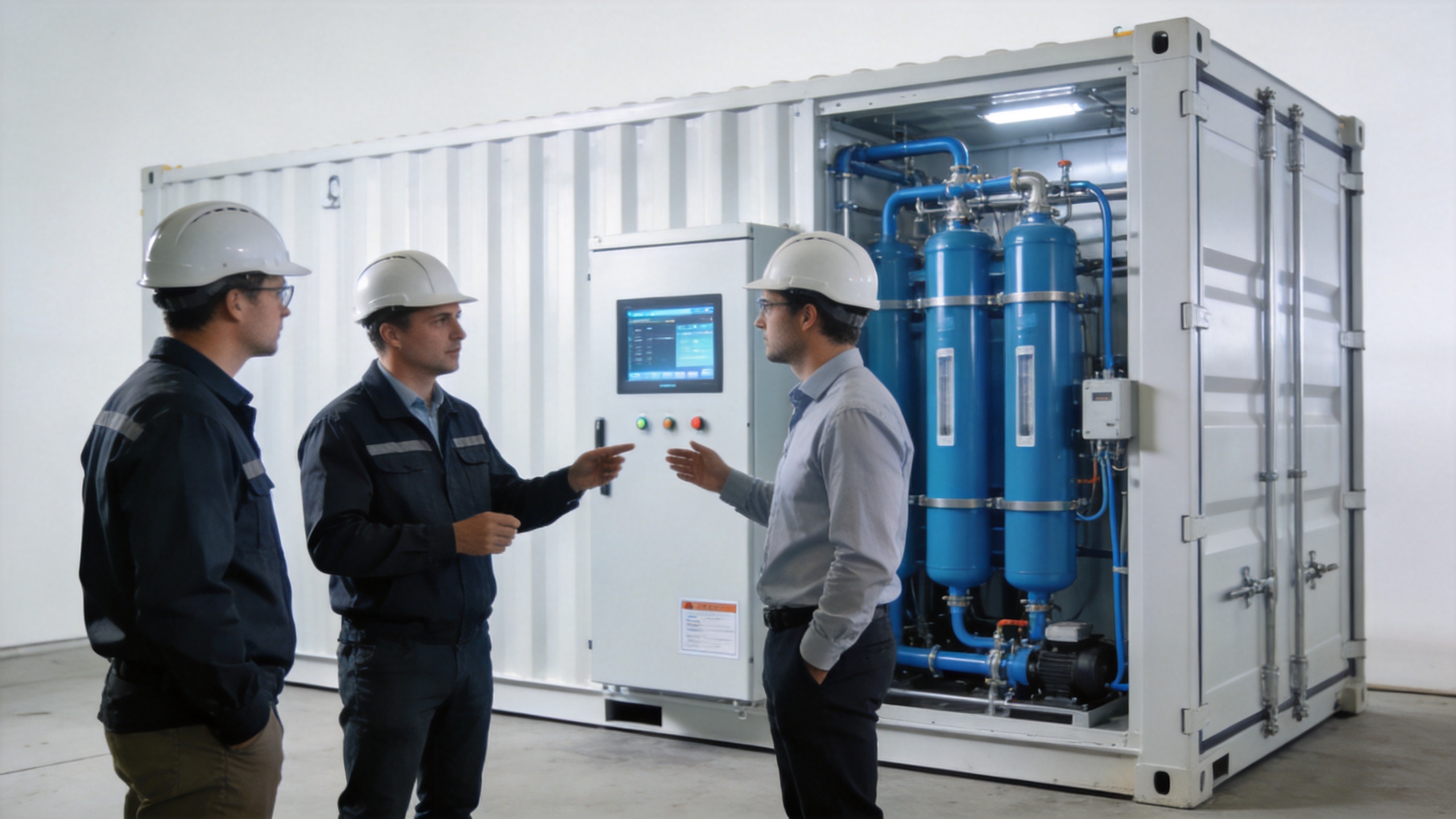
Check the site constraints before selecting a capacity range
A capacity calculation that ignores the site will usually need revision. Confirm the electrical connection and power quality, water source and treatment requirements, footprint, ventilation approach, hydrogen and oxygen handling boundaries, control interfaces, access for maintenance, and local permitting path. The equipment package must also fit the downstream pressure and purity requirement; an electrolyzer output alone may not represent the hydrogen condition the end-use equipment expects.
For packaged water-electrolysis hydrogen generators, ISO 22734 is a useful procurement checkpoint because it addresses construction, safety, and performance requirements. It does not remove the need to confirm local regulations, installation conditions, hazardous-area considerations, and the edition applicable to the project. Ask suppliers to clarify what is within their package boundary and what remains a site or integrator responsibility.
Choose between one large unit and a modular layout
There is no universal answer. One larger industrial hydrogen generator can simplify the equipment count and may suit a stable, well-defined base load. Multiple modules can help stage capital expenditure, support phased demand growth, and provide operating flexibility when one module is unavailable. The trade-off should be tested against controls, maintenance strategy, electrical distribution, footprint, and the consequences of a single-point outage.
For a decision-stage project, compare at least three cases: the present demand case, an expected-growth case, and a constrained-power case. In each case, list the production hours, storage requirement, utility demand, and required hydrogen delivery conditions. This makes capacity selection a transparent business and engineering decision rather than a comparison of headline ratings.
A practical capacity-selection checklist
- State hydrogen demand by day, hour, and peak event.
- Define the target delivery pressure, purity, and continuity requirement.
- Set the actual operating window based on power availability and maintenance assumptions.
- Calculate the average production rate, then test a reasonable margin with the supplier.
- Size buffer storage separately for peaks, downtime, and variable generation.
- Confirm electrical, water, footprint, ventilation, and control-interface constraints.
- Compare single-unit and modular options against the project expansion plan.
- Verify applicable safety requirements, including the relevant ISO 22734 scope and local rules.
Questions to resolve with an industrial hydrogen generator supplier
1. What duty cycle is assumed for the industrial hydrogen generator?
For metal hydride hydrogen storage, confirm how the expected charge and discharge cycle fits the production schedule.
2. What output boundary is quoted for the industrial hydrogen generator?
For metal hydride hydrogen storage, define whether compression and thermal management sit inside or outside the stated scope.
3. Can the industrial hydrogen generator follow the available power profile?
For metal hydride hydrogen storage, review the buffer role during variable generation and variable consumption.
4. What maintenance window applies to the industrial hydrogen generator?
For metal hydride hydrogen storage, check whether planned maintenance changes the reserve requirement.
5. Which utilities must be ready for the industrial hydrogen generator?
For metal hydride hydrogen storage, document water, thermal, electrical, and control interfaces separately.
6. What pressure reaches the battery limit from the industrial hydrogen generator?
For metal hydride hydrogen storage, compare that pressure with the downstream process requirement.
7. How will the industrial hydrogen generator support an expansion phase?
For metal hydride hydrogen storage, test whether capacity can be added without redesigning the operating philosophy.
8. What safety documents accompany the industrial hydrogen generator?
For metal hydride hydrogen storage, request the applicable safety information and the limits of the supplied package.
9. What data should the industrial hydrogen generator record?
For metal hydride hydrogen storage, agree on inventory, temperature, and cycle data needed for operations review.
10. How is availability defined for the industrial hydrogen generator?
For metal hydride hydrogen storage, distinguish usable reserve from nominal installed capacity.
11. Can the industrial hydrogen generator be commissioned in stages?
For metal hydride hydrogen storage, align staged commissioning with the readiness of the downstream hydrogen user.
12. Which party integrates the industrial hydrogen generator controls?
For metal hydride hydrogen storage, define alarms, interlocks, and communications responsibilities early.
Make the final decision on a system basis
The right industrial hydrogen generator capacity is the capacity that supports the required hydrogen outcome under real operating conditions. Start with demand, convert it into an hourly production requirement, then test it against power availability, storage, site interfaces, and future growth. That sequence keeps the decision grounded in the production target while avoiding unsupported assumptions about a particular configuration.
For a project review, prepare a one-page input sheet with demand profile, operating hours, delivery requirements, available utilities, preferred storage approach, and expansion horizon. It gives the engineering team a clear basis for evaluating whether a 100KW-500KW system, a 1MW-5MW system, or a staged modular approach is the better fit.