
 EN
EN

How to Choose Energy Storage for Renewable Energy Systems
Choosing energy storage for renewable energy systems is not mainly a question of picking the battery with the largest nameplate capacity. For B2B planners, the more useful starting point is the operating boundary: when renewable generation arrives, when the load must be served, how long an interruption can be tolerated, and what interfaces the site already has. Storage separates the timing of energy production from energy consumption, so it can turn variable solar or wind output into a more controllable energy service.
From a clean-energy planning perspective, a defensible decision connects generation, load, controls, safety, and long-term operations. The right answer may be a battery, hydrogen, thermal storage, a hybrid architecture, or a staged combination. The sections below provide a practical framework for comparing energy storage for renewable energy systems without assuming one technology fits every project.
Start With the Load and Reliability Requirement
Before comparing technologies, build an hourly view of the load. Identify the critical loads, their peak demand, their daily energy requirement, and the duration they must continue during a renewable shortfall. A site with brief power-quality events has a different requirement from a microgrid that must bridge overnight operation or several low-generation days.
Define reliability in operational terms. Is the goal peak shaving, self-consumption, backup power, islanded operation, or a predictable supply of electricity and hydrogen? Also document the allowable response time. Fast-response needs can favor electrochemical storage and power electronics, while longer energy gaps may justify a different storage medium. This is an easy point to overlook: a high power rating alone does not show whether the system carries enough usable energy for the required duration.
Match Storage Duration to the Renewable Profile
When evaluating energy storage for renewable energy systems, compare the duration of the mismatch rather than comparing technologies in isolation. Short, frequent swings from solar output, demand peaks, or grid constraints often call for rapid cycling and responsive controls. Longer gaps created by weather patterns, seasonal generation, or planned resilience targets can require a solution that stores energy over a much wider window.
| Planning question | What it helps determine | Why it matters |
|---|---|---|
| How long is the typical energy shortfall? | Required discharge duration | Prevents undersizing energy capacity. |
| How quickly must output change? | Power and control response | Separates fast balancing from long-duration supply. |
| How often will the asset cycle? | Duty profile and lifecycle assumptions | Links technology selection to operating reality. |
| Must surplus energy be retained for extended periods? | Long-duration or hybrid storage need | Highlights where hydrogen can be assessed alongside batteries. |
Battery storage is often considered where fast dispatch and daily cycling are priorities. Hydrogen pathways may be worth evaluating when a project needs to convert surplus renewable electricity into a storable energy carrier for longer-duration use, particularly when the site also has a hydrogen demand or a microgrid strategy. That is a conditional comparison, not a universal ranking; conversion losses, storage conditions, delivery requirements, and the value of the final energy service all need to be assessed together.
Compare Technologies by System Role, Not by a Single Metric
A useful energy storage for renewable energy systems comparison separates power, energy, duration, footprint, safety, maintenance, and integration. Cost should be considered across the full system boundary: equipment, civil works, controls, permitting, replacement planning, and operations. A lower initial equipment price does not automatically mean a lower lifecycle cost if it creates extra control complexity or fails to meet the required duty profile.
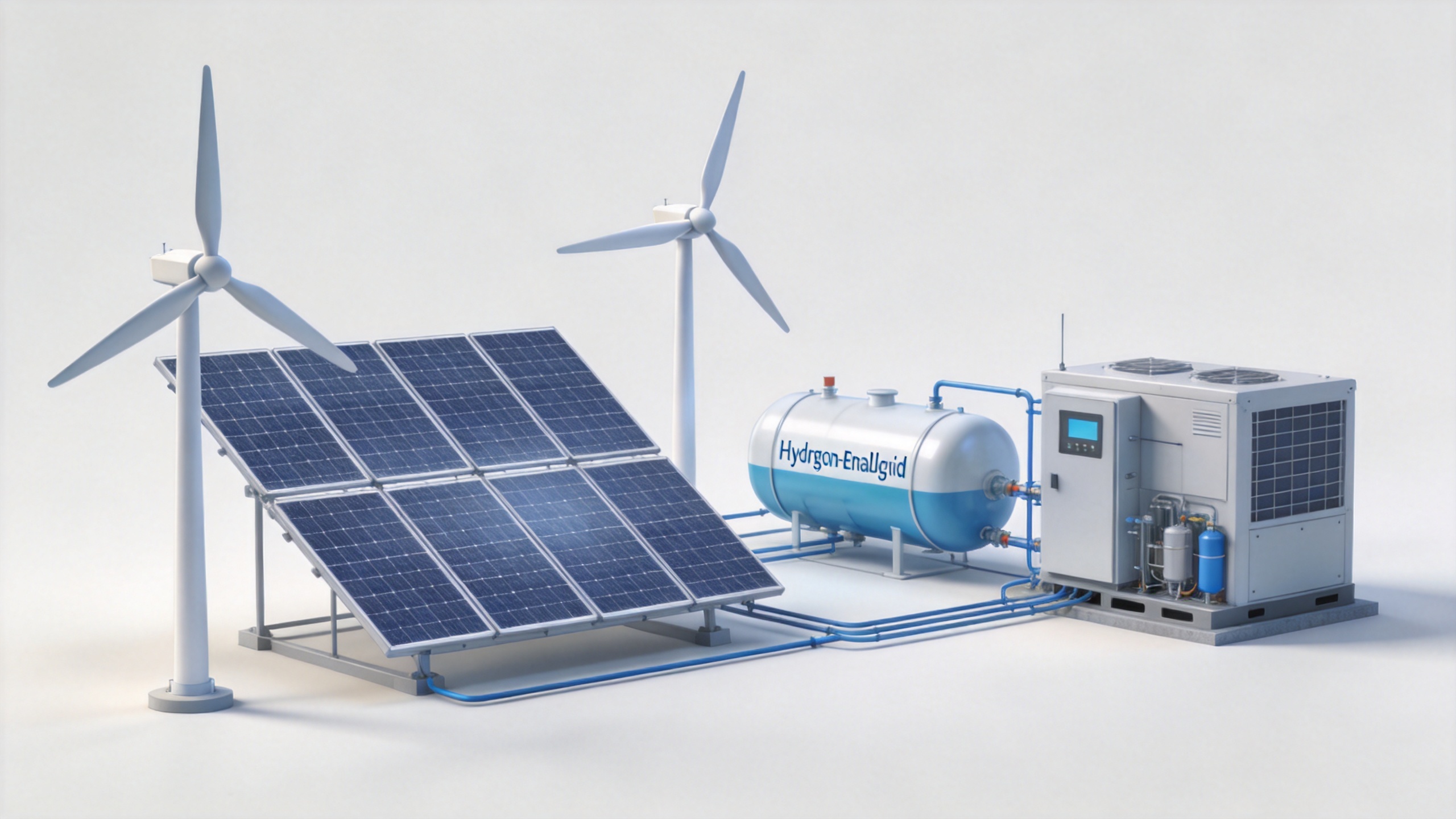
For example, a hybrid layout can assign fast fluctuations to batteries while reserving longer-duration energy management for another storage route. In a hydrogen-oriented microgrid, the energy chain can include renewable electricity, hydrogen production, storage, and reconversion or direct end use. The appropriate architecture depends on verified load behavior and site interfaces, not on a technology label alone.
Check Integration, Controls, and Safety Early
Technical selection should move in parallel with integration review. Map renewable inverters, grid connection points, switchgear, energy-management controls, communications protocols, and protection requirements. Confirm which system is responsible for dispatch decisions, islanding logic, alarms, and data retention. A storage asset can perform well on paper yet be difficult to operate if control authority and interface ownership are unclear.
Safety planning deserves the same discipline. Review the storage medium, ventilation or thermal-management needs, detection and shutdown logic, access control, emergency procedures, local codes, and the responsibilities of each supplier. If hydrogen is part of the design, also verify production, storage, piping, compression where applicable, and end-use interfaces as one coordinated system. Site-specific requirements should be confirmed during engineering rather than inferred from a generic configuration.
Plan for Operations and Lifecycle Decisions
A suitable choice for energy storage for renewable energy systems remains useful only if the owner can operate and maintain it. Ask what data will be monitored, who will review performance, how maintenance windows affect availability, and how replacement or expansion will be handled. Establish acceptance criteria that connect to the original business case: delivered energy, response behavior, uptime expectations, and the conditions under which performance will be reassessed.
For projects exploring a hydrogen-centered architecture, a Hydrogen microgrid integrated solution can be evaluated as part of the broader integration discussion. The product page should support—not replace—site-specific engineering review of load, generation, safety, and controls.
A Practical Selection Checklist
- Measure renewable generation and critical-load profiles at the required time resolution.
- Set reliability, response-time, and outage-duration targets.
- Compare candidate technologies against the required power, energy, duration, and cycling profile.
- Model system-level costs and operating assumptions rather than equipment price alone.
- Review integration, protection, safety, and control ownership before final selection.
- Define performance monitoring, maintenance responsibilities, and expansion triggers.
In short, selecting energy storage for renewable energy systems is a matching exercise. Begin with the load and reliability requirement, test technologies against the duration of the energy gap, and then validate integration and operational conditions. This sequence makes it easier to identify whether a battery-only, hydrogen-enabled, or hybrid solution is the stronger fit for the project.