
 EN

How Hydrogen Energy Storage Supports Renewable Power Projects
Renewable generation is abundant when the weather cooperates and demand is low, but a power project still needs a plan for the electricity produced outside those moments. Hydrogen energy storage gives developers a way to convert part of that surplus wind or solar output into a storable energy carrier. Instead of treating curtailment as an unavoidable loss, the project can use renewable electricity to run an electrolyser, store the resulting hydrogen, and later use it where the project needs flexible energy.
For B2B teams evaluating renewable energy storage systems, the value is not that hydrogen replaces every other storage technology. It is that hydrogen energy storage can extend the time horizon of a project—particularly when the requirement moves beyond intraday balancing toward multi-day, seasonal, resilience, or multi-use energy planning.
Why renewable power projects need more than short-duration storage
Solar and wind output vary by hour, weather pattern, and season. Batteries are often well suited to fast response and shorter shifting windows. Yet a project may also face longer gaps: prolonged low renewable output, seasonal production differences, constrained grid connections, or a need to preserve energy for a later operational event. In those cases, hydrogen energy storage adds a chemical storage pathway alongside electrical storage.
A useful project question is therefore not “battery or hydrogen?” but “which duration, duty cycle, and end use does each asset serve?” The U.S. Department of Energy groups technologies capable of 10 or more hours of storage within its long-duration storage focus. Its assessments also describe bidirectional hydrogen storage for seasonal scenarios extending beyond 700 hours. These are planning references rather than performance guarantees for a particular facility, but they illustrate why a longer storage horizon changes system design.
How hydrogen energy storage captures surplus wind and solar power
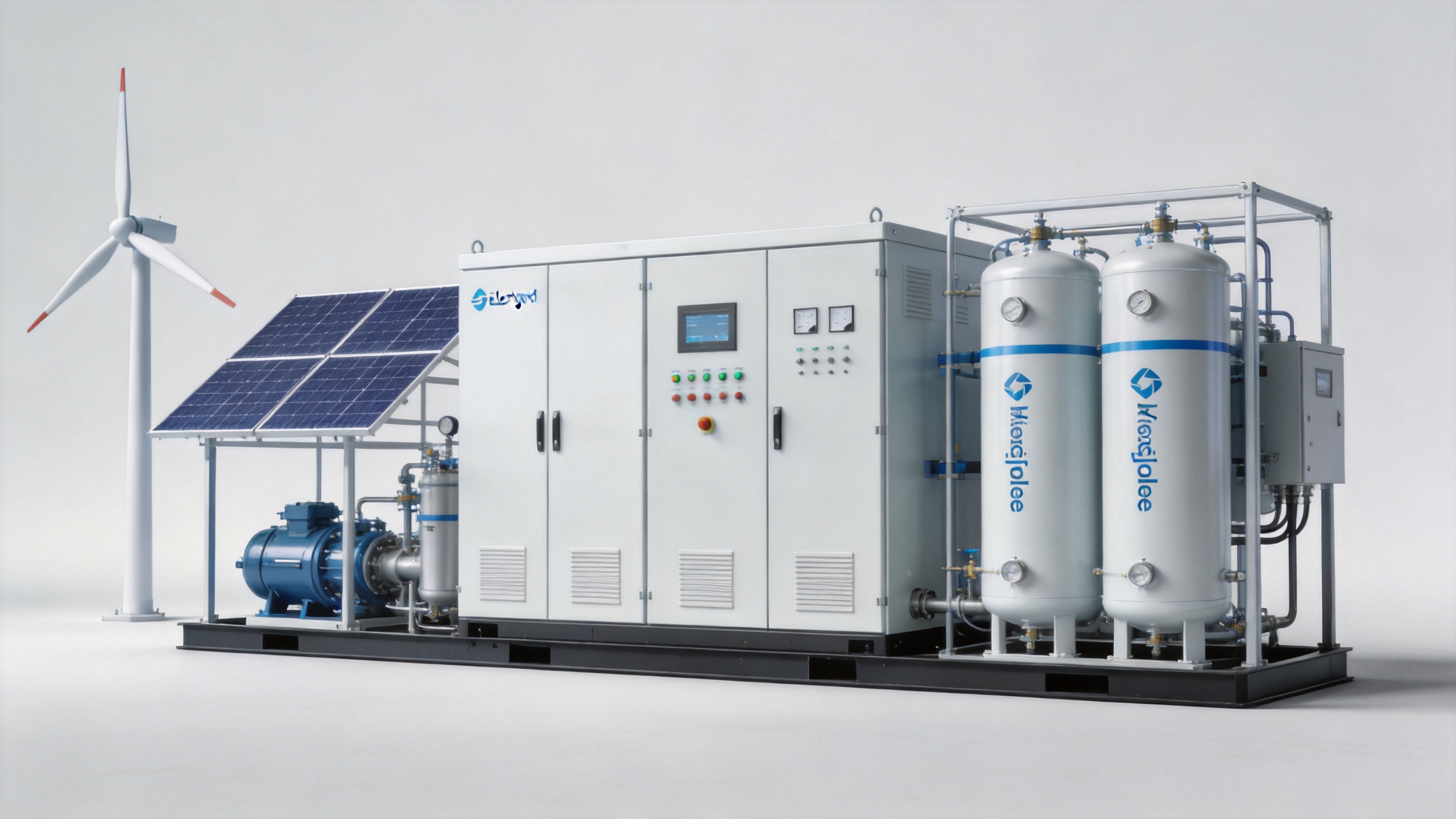
The core sequence is straightforward. When renewable generation exceeds the value of immediate export or on-site consumption, an electrolyser uses electricity to split water into hydrogen and oxygen. The hydrogen is then stored using a pathway selected for the project’s capacity, site conditions, safety case, and required discharge profile. Later, it can be supplied to a fuel cell or other approved end-use equipment, or used directly as a feedstock where a viable demand exists.
- Measure surplus: use generation forecasts, curtailment history, and load data to identify when power is available.
- Convert selectively: operate electrolysis within the project’s electrical, water, and control constraints.
- Store for the right duration: align the storage method with how long the energy must remain available.
- Dispatch by priority: reserve hydrogen for resilience, later power generation, industrial use, or a defined combination of these uses.
This power-to-hydrogen pathway can help a project absorb output that would otherwise be curtailed. It also turns a single-purpose renewable generator into a more flexible energy platform, provided that the full system is designed around realistic operating conditions and safety boundaries.
Where hydrogen energy storage strengthens project resilience
Hydrogen energy storage is especially relevant when a project must retain energy through longer disruptions rather than simply smooth a daily peak. A remote microgrid, a facility with critical loads, or a renewable project operating under a limited interconnection can use stored hydrogen as one element of a resilience plan. The design still needs clear boundaries: what loads are critical, what autonomy period is required, what conversion equipment is installed, and how the system will be tested.
For example, a hydrogen microgrid concept can combine renewable generation, controls, electrolysis, storage, and later electrical supply in a coordinated architecture. The appropriate configuration depends on the load profile and interfaces—not on a generic claim that one equipment package fits all projects. Teams exploring this route can review Hyto’s Hydrogen microgrid integrated solution as a starting point for a project-specific technical discussion.
Long-duration storage creates additional options for renewable assets
Because hydrogen is an energy carrier, it can support more than one value stream when the project has a credible route to use it. A developer might prioritize later electricity supply, reserve capacity for critical operations, or coordinate production with an industrial hydrogen demand. That flexibility can improve the usefulness of surplus renewable output, but it should be evaluated with transparent assumptions about energy conversion, storage, delivery, operating hours, and offtake.
This is also why long-duration hydrogen energy storage should be assessed at the system level. The relevant measure is not just electrolyser capacity or stored hydrogen volume. It is the relationship among renewable availability, storage duration, conversion assets, dispatch requirements, site utilities, operating procedures, and future expansion. A programme-level view can make those interfaces easier to map. For related planning context, see Hyto’s Long-term Energy Storage Programme.
A practical evaluation framework for project teams
Before specifying hydrogen energy storage, project owners and engineering teams should document the business problem the storage system must solve. Start with the renewable profile and the load profile, then test storage options against the same decision criteria.
| Decision area | Questions to answer |
|---|---|
| Storage duration | Is the need hourly, daily, multi-day, or seasonal? |
| Renewable input | How much wind or solar output is forecast to be surplus, and when? |
| Dispatch purpose | Will hydrogen support power resilience, an on-site process, or multiple uses? |
| Site integration | What electrical interfaces, water conditions, footprint, controls, and safety requirements apply? |
| Operating model | Who will monitor the assets, maintain the equipment, and validate availability? |
| Expansion path | Can the project scale as renewable capacity, demand, or storage needs change? |
Using this framework early helps avoid a common mistake: selecting a storage technology before defining the duration and service the project actually needs. It also makes technical conversations more productive because assumptions can be checked rather than left implicit.
Hydrogen energy storage as part of an integrated strategy
The strongest case for hydrogen energy storage usually emerges when it complements, rather than competes with, other flexibility tools. Batteries may manage fast and frequent cycling. Demand response and grid export may handle part of the variability. Hydrogen can add value where energy needs to be retained for a longer period, converted into a usable molecule, or held for resilience and future dispatch.
For renewable project developers, the next step is to quantify the surplus-energy pattern, define the target storage duration, and evaluate the full conversion-and-storage chain under site-specific conditions. With that evidence in place, hydrogen energy storage can become a practical route for turning intermittent renewable output into a more dispatchable and resilient project resource.