
 EN

Green Ammonia Plants: Hydrogen Supply Questions for Project Developers
A green ammonia plant is often introduced as a simple chain: renewable electricity makes hydrogen, air separation supplies nitrogen, and the synthesis loop produces ammonia. For project developers, the difficult work lies in the interfaces between those blocks. Hydrogen is not merely a feedstock line item. Its availability, pressure, purity, storage, and operating profile determine whether the green ammonia plant can run predictably when renewable generation changes.
This article takes a project-development view of green hydrogen production. It focuses on the questions that should be resolved early enough to influence capacity selection, contracting, plot planning, controls, and risk allocation—not after the ammonia loop and electrolyzer packages have already been specified.
Start with the hydrogen demand profile, not only annual ammonia output
An annual production target is necessary, but it is not a sufficient basis for sizing hydrogen supply to a green ammonia plant. The synthesis loop has a preferred operating range, start-up behavior, minimum stable load, and response limits. Renewable generation, by contrast, may vary by hour, season, and weather event. A developer should ask how much hydrogen the ammonia unit needs at each operating state: normal load, turndown, start-up, shutdown, and recovery after a power interruption.
A useful early deliverable is a time-based hydrogen balance. It should show hydrogen production, consumption, compression, losses, storage inventory, and planned curtailment over representative periods. This makes hidden design choices visible. For example, a plant can rely on a larger electrolyzer fleet, more hydrogen buffering, more flexible ammonia synthesis, imported power, or a combination of these options. Each path changes capital cost, operating cost, and the reliability narrative offered to lenders and offtakers.
Do not let “average daily production” mask the problem. A green ammonia plant may meet an annual target on paper while experiencing frequent short hydrogen intervals that force inefficient operation or reduce dispatchability.
How should electrolyzer capacity be matched to renewable power?
Electrolyzer nameplate capacity should be tested against the actual renewable-power profile, grid connection rules, planned curtailment, and maintenance philosophy. The central question is not simply, “How many megawatts are needed?” It is, “How many operating hours at what load can the hydrogen system realistically deliver, and what happens outside that envelope?”
Developers should require scenario modeling for high-resource periods, low-resource periods, rapid ramps, and extended low-generation events. Include auxiliary loads, water treatment, cooling, compression, and control power rather than modeling only the electrolyzer stack. If the project is phased, also verify whether early hydrogen capacity can serve the first ammonia train without locking the later expansion into an inefficient layout.
Modular equipment can support staged development when the system boundaries are clear. For early capacity blocks, developers can review available 100KW-500KW hydrogen production systems as a starting point for discussing package interfaces. Larger expansions may call for a separate review of 1MW-5MW system configurations. These links identify equipment categories only; final selection should follow the project’s verified electrical, water, safety, and process requirements.
What level of hydrogen storage is needed?
Hydrogen storage is the bridge between variable production and a process that benefits from steadier feed. The storage question should be framed in hours of coverage and operating purpose, not as a generic vessel-size exercise. Is the buffer intended to absorb short renewable ramps, cover daily variation, protect the synthesis loop during a longer renewable shortfall, or support planned maintenance? One storage solution may not perform equally well across all four roles.
For each scenario, define the required usable inventory, charge and discharge rate, pressure range, compression duty, heat management, safety separation, and control logic. Also clarify where the battery limits sit between electrolyzer, compressor, storage, nitrogen supply, and ammonia synthesis. A green ammonia plant can suffer avoidable interface risk when one contractor assumes another contractor is responsible for pressure control, vent handling, or impurity monitoring.
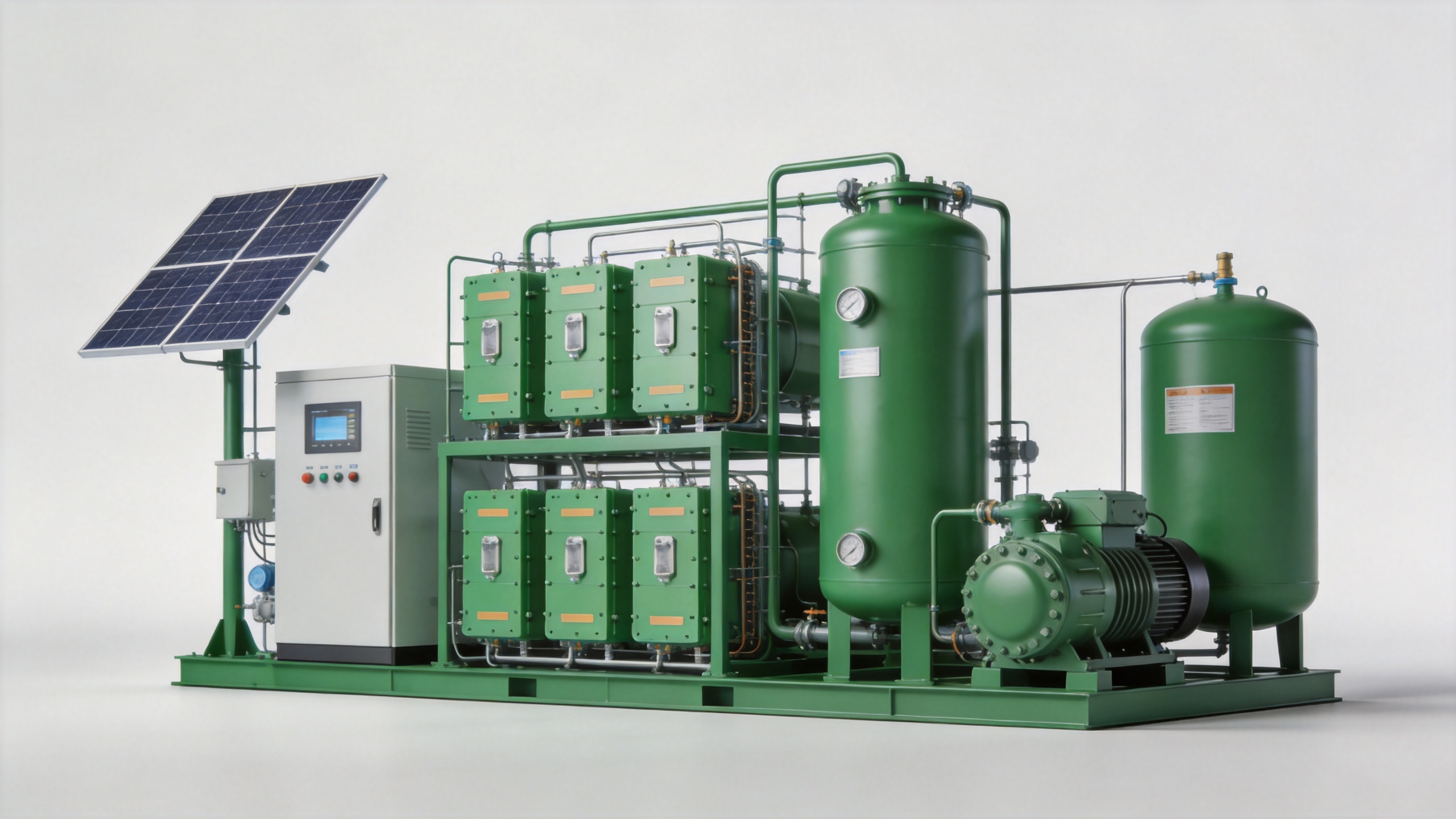
Solid hydrogen storage may be evaluated as one pathway in a broader buffering strategy where site constraints, safety objectives, duty cycle, and system integration support its use. It should be assessed against the project’s actual temperature management, response-time, footprint, and lifecycle requirements rather than treated as a universal substitute for other storage approaches.
Define hydrogen quality and delivery conditions before procurement
Hydrogen for ammonia synthesis must arrive at an agreed condition. The specification should cover purity, moisture, oxygen-containing species, inert gases, pressure, temperature, flow range, sampling method, analyzer availability, and response when an excursion occurs. This is not an administrative appendix. Catalyst protection, synthesis-loop stability, and commissioning readiness can all depend on it.
Project teams should translate the ammonia-licensor requirements into a single interface document that applies to the electrolyzer vendor, purification provider, compressor supplier, storage package, EPC contractor, and operations team. Require clear acceptance testing and a decision tree for off-spec hydrogen: isolate, recycle, store, blend, reduce load, or shut down. Without this agreement, commissioning disputes can emerge at the very point when each package is technically “complete” but the integrated plant is not.
Plan the operating model and controls architecture
A green ammonia plant needs an operating philosophy that connects power forecasting, electrolyzer dispatch, storage control, ammonia-loop constraints, and commercial commitments. Developers should test who owns the forecast, who can change production targets, how control priorities are ranked, and how the plant behaves during communications loss or a safety trip.
Useful workshops bring process, electrical, automation, commercial, and operations stakeholders into the same room. Review alarm ownership, cyber boundaries, data quality, maintenance windows, spare-parts strategy, and KPIs such as hydrogen availability, usable storage coverage, renewable utilization, and ammonia production stability. The goal is an operating system that works across package boundaries, not a set of individually compliant packages.
Six gate questions for a green ammonia plant
Before freezing the basis of design, put these short questions into the green ammonia plant decision record:
- Can the green ammonia plant meet its planned output under a conservative renewable-resource case?
- Does the green ammonia plant have a documented response to an extended low-power interval?
- Which party guarantees the green ammonia plant hydrogen delivery envelope at each battery limit?
- How will the green ammonia plant prove hydrogen quality during commissioning and normal operation?
- What usable storage coverage protects the green ammonia plant from short-duration variability?
- Who has authority to adjust the green ammonia plant load when forecasts and offtake commitments conflict?
A developer checklist for hydrogen-supply readiness
- Have hourly and seasonal hydrogen balances been modeled against ammonia-loop operating limits?
- Are electrolyzer capacity, renewable availability, auxiliary loads, and grid assumptions documented in the same model?
- Is the storage duty defined by coverage time, flow rate, pressure, and upset scenario?
- Are hydrogen purity, delivery pressure, sampling, and off-spec procedures agreed across package boundaries?
- Is there one integrated controls and operating philosophy for power, hydrogen, storage, and synthesis?
- Do EPC scopes assign ownership for every physical and data interface?
Conclusion
The strongest green ammonia projects treat hydrogen supply as an integrated operating system. By resolving demand variability, electrolyzer sizing, storage duty, gas quality, and control ownership early, developers can make a green ammonia plant easier to finance, build, commission, and operate. The next practical step is an interface-led design review that tests the hydrogen chain under realistic renewable and ammonia-loop scenarios.