
 EN

AEM Electrolysis and Flexible Operation: What Project Developers Need to Know
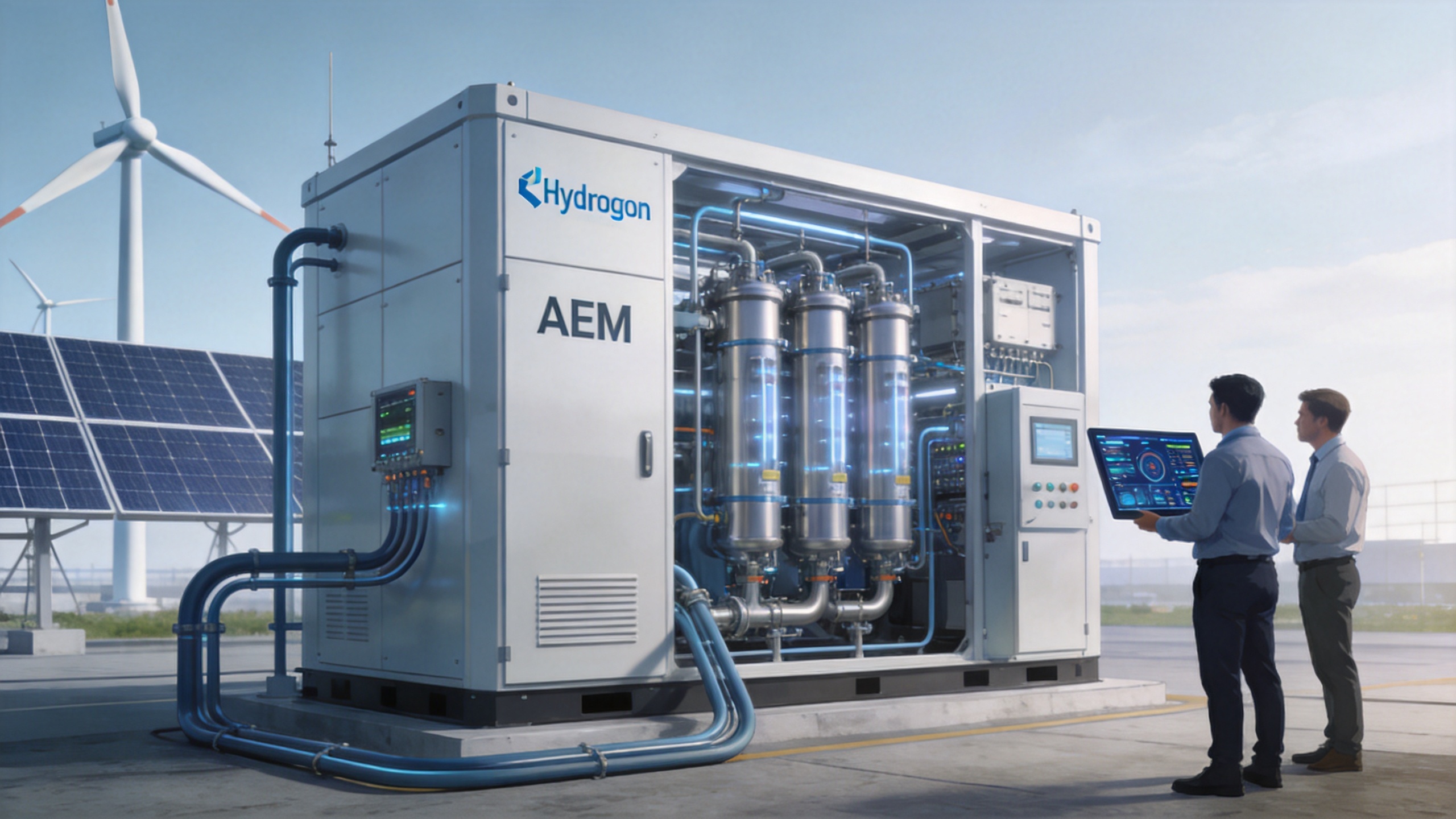
For a project developer, an AEM electrolyser is not only a stack-selection question. It is a system-design question: how will renewable power vary, what hydrogen demand must be met, and which operating states will the balance of plant experience? AEM electrolysis uses an anion-exchange membrane to split water into hydrogen and oxygen. Its emerging position between established alkaline and PEM approaches makes it relevant to teams that need to assess cost, materials, responsiveness and integration without treating any one attribute as decisive.
Start with the application boundary. A project with a firm daily offtake has different needs from one that follows curtailed solar or wind output. In either case, the AEM electrolyser should be assessed as part of an energy, water, gas-handling and controls package—not as an isolated nameplate rating.
Why flexible operation changes the AEM electrolyser conversation
Flexible operation means more than a fast ramp from one power level to another. For an AEM electrolyser, it can include start-up and shutdown frequency, time at low load, standby state, pressure transitions, temperature recovery, power-quality events and the way several modules are dispatched together. These conditions affect how the project turns renewable availability into hydrogen production.
Published reviews of dynamic water electrolysis describe the importance of evaluating changing temperature and pressure alongside electrical transients. That is a useful reminder for developers: a promising stack response does not automatically describe the behavior of water treatment, pumps, gas drying, compression, cooling or plant controls. Ask what is included in each test result before using it in a financial model.
The question is therefore not whether an AEM electrolyser is “flexible” in the abstract. The practical question is whether its verified operating envelope fits the project’s expected duty cycle. If the site has short solar ramps, frequent cloud events, nighttime stops or a grid-support dispatch plan, those cases should appear in the technical specification and acceptance plan.
Define the duty cycle before comparing equipment
Before requesting quotations for an AEM electrolyser, convert the renewable-resource study and hydrogen offtake profile into a small set of operating cases. Include a normal production day, a low-resource day, a rapid ramp day, a planned standby period and restart conditions after a longer outage. This gives suppliers a common basis for response and exposes assumptions that would otherwise remain hidden.
- Power profile: state expected minimum, nominal and maximum available power, ramp pattern and curtailment strategy.
- Hydrogen requirement: define whether delivery is continuous, scheduled or buffer-supported, including pressure and purity requirements at the battery limit.
- Operating states: distinguish hot standby, warm standby, low-load holding, shutdown and restart rather than grouping them as “off.”
- Site interfaces: identify water quality, cooling conditions, electrical conversion, storage, compression and control-system responsibilities.
This approach helps teams compare an AEM electrolyser on applicable evidence rather than headline claims. It also helps the EPC team test whether a proposed operating philosophy creates avoidable cycling in supporting equipment.
Separate stack dynamics from plant dynamics
A stack may respond on one timescale while the full AEM electrolyser plant responds on another. Water preparation may need stable inlet conditions. Thermal equipment has inertia. Gas processing and compression can impose pressure or flow constraints. The controls architecture must coordinate these pieces without sending conflicting commands during an upset.
That distinction matters in early design. A developer who models only annual energy consumption and nameplate hydrogen output may miss the effect of minimum load, restart losses, auxiliary consumption or storage buffering. A better model uses time-series renewable data and maps it to declared operating states for the AEM electrolyser and its auxiliaries.
There is also a system-level trade-off: maximizing instantaneous renewable use may differ from minimizing transitions or meeting a delivery commitment. The right dispatch rule depends on project economics, storage design and supplier-validated limitations. More accurately, it depends on the conditions documented for the specific configuration.
Documents to request from an AEM electrolyser supplier
Technical due diligence is stronger when requests are precise. For each proposed AEM electrolyser, ask for evidence tied to the offered configuration rather than generic technology literature.
| Evidence request | Why it matters |
|---|---|
| Declared operating envelope and minimum-load rules | Supports dispatch modelling and identifies whether low-power periods need standby or storage support. |
| Ramping, start-up and shutdown test protocol | Shows the initial conditions, measurement window and balance-of-plant scope behind response claims. |
| Temperature, pressure and water-quality requirements | Clarifies utility design, control interlocks and site interfaces. |
| Degradation assumptions and maintenance plan | Allows lifecycle assumptions to be checked against the intended duty cycle. |
| Control architecture and alarm philosophy | Helps the developer evaluate renewable coupling, remote operation and safe transition handling. |
Ask suppliers to identify which values are contractual inputs, which are design assumptions and which require site-specific validation. This is especially important for an AEM electrolyser because operating conditions, component choices and system integration can materially change the result.
Use modularity as a project-design tool
For some projects, modular design can create more operational choices than a single large block. Modules can be sequenced to follow available power, taken offline for maintenance or held in defined states while other modules operate. That does not remove the need for validation, but it can give the AEM electrolyser plant a clearer dispatch strategy.
Hyto Energy provides a 1MW-5MW hydrogen production system page that can serve as a starting point for a project-scale discussion. Developers should still confirm the exact system boundary, flexible-operation requirements and site interfaces with the supplier before using any configuration in design calculations.
A practical next step for developers
Build a one-page operating brief before beginning technical clarification. Include the renewable profile, hourly hydrogen demand, storage concept, planned operating states, utility conditions and acceptance tests. Then ask each supplier to respond against the same brief. This turns an AEM electrolyser comparison into a transparent engineering exercise instead of a collection of incomparable figures.
In short, an AEM electrolyser may be a relevant option for renewable-hydrogen projects, but flexible operation has to be designed and evidenced at plant level. The most useful next conversation is one that defines the duty cycle, verifies the operating envelope and tests how the complete system behaves when power changes.