
 EN
EN
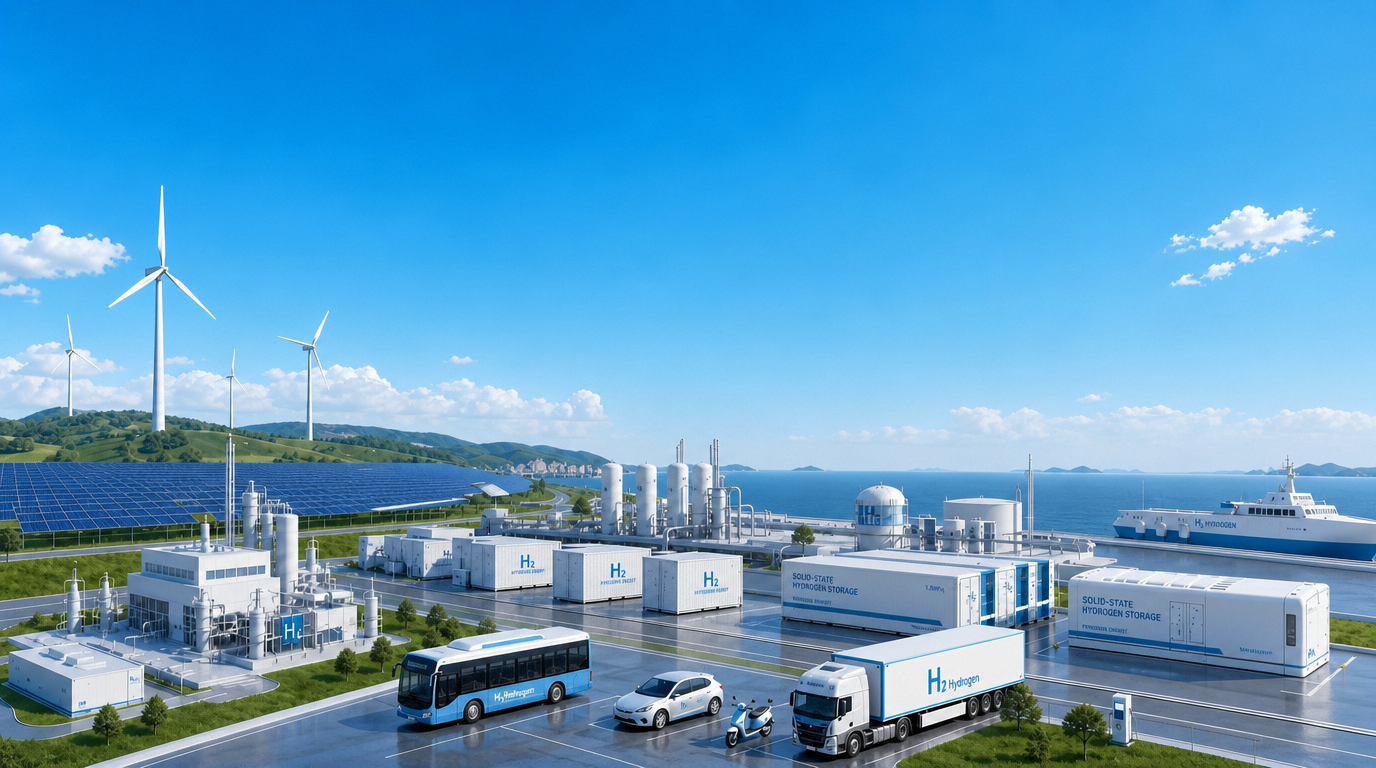
In short: Most hydrogen systems are centralized designs shrunk down to a smaller size — and that is why so many distributed projects stall on cost and permitting. The fix is to pick components for the constraints that actually apply at the point of use: intermittent power, small capacity increments, low-pressure safety, no trucking. That specification points to a specific pairing — AEM electrolysis for production, metal-hydride solid-state storage for buffering. This article covers why each half fits, what the published performance numbers actually say, and which problems are still open.
The mismatch nobody wants to talk about
Green hydrogen has been built on an assumption of scale. Project announcements are counted in hundreds of megawatts. Electrolyzer factories are sized for gigawatts. Cost curves are drawn against the premise that one very large plant will serve one very large offtaker, connected by a pipeline that already exists.
Real hydrogen demand rarely looks like that.
The places that actually need hydrogen — a refuelling station on a logistics corridor, a metals plant running a single furnace, a greenhouse, a data centre's backup power, a remote microgrid that currently burns diesel — are small, dispersed, and almost never sitting on top of a pipeline. For them, centralized production means paying for compression, high-pressure storage, trucking and dispensing on top of the production cost. In many distributed cases, that delivery chain costs more than making the hydrogen in the first place.
The honest question is therefore not "how do we make centralized hydrogen cheaper?" It is: what does a hydrogen system look like when it is designed for distribution from first principles, instead of being a scaled-down copy of a refinery?
The answer is specific: AEM electrolysis for production, metal-hydride solid-state storage for buffering.
Why both incumbent electrolyzer technologies fall short at small scale
There are two mature ways to split water today, and both were optimized for something other than distributed duty.
Alkaline electrolysis is cheap and durable, but it is built for steady-state operation. Large alkaline stacks dislike the ramp rates that come with solar and wind. They also run with a liquid electrolyte (typically KOH), which brings caustic handling, gas scrubbing, and a minimum load below which the system cannot operate at all. That is precisely the wrong profile for a unit that should follow a rooftop PV array.
PEM electrolysis solves the dynamics problem. It ramps fast, runs at high current density, produces clean high-purity hydrogen, and works over a wide load range. It also depends on iridium at the anode and platinum-group metals in the cell — a structural cost and supply-chain exposure you cannot engineer away with volume alone. PEM's strength is real, but it is expensive to replicate at every demand point.
AEM — anion exchange membrane — sits deliberately in between. It borrows PEM's cell architecture (thin membrane, dry cathode, high-purity output, fast response, wide turndown) while using alkaline-like chemistry that does not require iridium or platinum. The result behaves like PEM and is built from materials more like alkaline.
What the published AEM numbers actually say
The performance figures are now credible rather than aspirational. Enapter's megawatt-class AEM systems were announced at 51.3 kWh per kg of hydrogen in May 2025, improved from 53.3 kWh/kg. At hydrogen's lower heating value (33.33 kWh/kg), 53.3 kWh/kg corresponds to roughly 62.5% system efficiency — and note that this is measured at 35 bar output pressure and ~99.9% purity, not at atmospheric pressure with a wet, dirty gas stream.
The comparable 1 MW unit is rated at up to 210 Nm³/h (≈450 kg/day), 99.95% purity (up to 99.999% with an optional dryer), 35 bar output, and a turndown range of 3% to 100% load.
That last number matters more than the efficiency figure. A 3–100% turndown range is what allows an electrolyzer to be powered directly by an intermittent source instead of by a grid contract.
And because the architecture is modular — many identical small stacks rather than one large cell — capacity scales in small increments, a failed stack is a maintenance item rather than an outage, and there is no minimum plant size below which the economics collapse.
Want the full specification? Download the [PRODUCT-LINE] technical spec sheet →
Solid-state storage: giving up pressure without giving up density
If AEM solves production, the storage side of distributed hydrogen has its own default answer — and the default is wrong.
Compressed hydrogen at 350–700 bar is the standard approach, and it drags a specific set of costs behind it: expensive composite vessels, multi-stage compression with its own energy penalty, strict separation distances, periodic requalification, and a vessel that is either full or being filled. In a distributed setting, the compressor alone can be a disproportionate share of the balance of plant.
Metal hydrides store hydrogen as a solid. Hydrogen is absorbed into a metal alloy to form a hydride, and released on demand by applying heat. There is no free gas at high pressure — the working pressure for charging is typically below 5 MPa, and the hydrogen is chemically bound rather than merely squeezed.
Three consequences follow, and they are the reason this belongs in a distributed system.
Safety is structural, not procedural
With hydrogen bound in a solid, a leak does not produce a large flammable cloud, and a puncture does not release the full inventory at once. Desorption is a slow, heat-limited process — under a fire or impact scenario the material cannot dump its contents instantly, which removes the worst secondary-accident pathway. This is a property of the material, not of an added safety system. It can also materially simplify permitting at sites that sit close to people.
Volumetric density is genuinely high
Published comparisons put metal hydride volumetric energy density at roughly 2 to 4.4 times that of hydrogen compressed to 35 MPa. Distributed sites are usually space-constrained, so this is the metric that decides whether a storage unit physically fits.
No boil-off, no self-discharge
Unlike liquid hydrogen, nothing evaporates while the system sits idle. Long-duration standby storage — exactly what backup-power and seasonal-buffer applications need — becomes practical.
The trade-off is honest and should be stated plainly: hydrides are heavy. Gravimetric capacity is the weak axis.
|
Material |
Reversible gravimetric capacity |
Desorption temp. |
Desorption pressure |
Notes |
|
LaNi₅ (lanthanum-nickel) |
~1.4–1.6 wt% |
~20 °C |
0.2–0.8 MPa |
Ambient-temperature operation, fast kinetics, mature and widely deployed |
|
TiFe (titanium-iron) |
~1.8–1.9 wt% |
~20 °C |
0.2–1.0 MPa |
Low cost, ambient operation, activation can be finicky |
|
TiMn₂ (titanium-manganese) |
~2.0–2.1 wt% |
~20 °C |
0.5–1.0 MPa |
Good cycling stability |
|
V–Ti–Cr (BCC solid solution) |
~3.5–3.8 wt% |
~20 °C |
0.1–0.3 MPa |
Highest ambient-temperature capacity, but poorer cycling life and higher cost |
|
MgH₂ (magnesium hydride) |
~7.6 wt% theoretical (~5.5 wt% reversible in practice) |
~280–300 °C |
~0.1 MPa |
By far the lightest option, but needs high-grade heat to release |
How to read this table: for ambient-temperature distributed buffering, the intermetallic family (LaNi₅, TiFe, TiMn₂) is the workhorse. Magnesium-based systems win on weight and raw-material cost but only make sense where a high-temperature heat source already exists — industrial waste heat, for instance, or a high-temperature process stream.
One more property is quietly important: because desorption is endothermic, the storage unit consumes heat when it gives hydrogen back. Coupled to a fuel cell this is a feature rather than a bug — published work indicates a hydride system can absorb on the order of 20–30% of a fuel cell's waste heat during desorption, which simultaneously eases the fuel cell's cooling burden and improves overall system efficiency. Compressed storage gives you nothing back.
See how it fits together: Explore our solid-state hydrogen storage range →
Why the two halves belong together
Individually, each is a good component. Together, they close a loop that neither closes alone.
The architecture is short: renewables → DC bus → AEM electrolyzer → hydrogen at ~35 bar → metal hydride storage → fuel cell or dispenser. No multi-stage compression to 700 bar. No liquid hydrogen. No delivery truck.
The specific synergies:
- Dynamic matching. The electrolyzer's 3–100% turndown tracks the renewables; the hydride buffer absorbs the mismatch between production and demand without needing a high-pressure cascade.
- Pressure compatibility. AEM output pressure and hydride charging pressure are in the same order of magnitude. You are not buying an expensive compression stage just to make the two ends talk to each other.
- Thermal integration. The fuel cell's waste heat drives hydride desorption. Electricity in, electricity out — with heat doing useful work instead of being rejected to atmosphere.
- Safety at the point of use. A distributed site is usually near people: a depot, a campus, a building. Low-pressure solid storage changes the risk profile of the whole installation.
- Scale matching. Modular AEM stacks and modular hydride canisters both scale in small steps, so a 50 kW site and a 2 MW site use the same technology — not two different product families.
Where this wins first
Refuelling at the point of demand. A depot or logistics hub that produces and stores its own hydrogen avoids the delivered cost of trucked gas, which for small volumes is the dominant line item.
Microgrids displacing diesel. Solar-plus-storage-plus-hydrogen becomes viable where the alternative is diesel gensets and fuel logistics to a remote site — and the seasonal storage property matters here in a way it does not for batteries.
Industrial backup and critical power. Data centres, telecom sites and cold chains need long-duration, low-maintenance standby. Solid storage has no self-discharge, and the system can be exercised without venting product.
Islanded industrial heat and feedstock. Where a plant already has waste heat, a magnesium-based system can pair high gravimetric capacity with a heat source that is otherwise thrown away.
Research and pilot lines. Wide turndown and modular capacity make AEM practical for facilities that cannot justify a megawatt-scale minimum.
The economics, stated honestly
The cost story is improving fast, but it is worth separating published company figures from third-party verified results.
Enapter has publicly targeted an electrolyzer capital cost of €550/kW at volume, down from roughly €3,333/kW at small-batch production. The company has also stated that a 1 MW AEM unit could reach around $2.26/kg of hydrogen at an electricity price of €30/MWh, rising to about €3.33/kg at €50/MWh, assuming a 98% load factor. These are company projections tied to specific assumptions — treat them as directional, not as an audited benchmark.
What is not projection is the structural logic: renewable electricity is the dominant cost of green hydrogen, so system efficiency sets the floor on levelized cost. At 51–53 kWh/kg, AEM is competitive with — and in some configurations better than — typical alkaline and PEM system efficiencies, and it achieves that without iridium. For distributed production the efficiency number matters more than the capex number, because you are often buying electricity at retail or near-retail prices rather than industrial wholesale rates.
On the storage side the trade is different: you are trading the capital cost of alloy against the avoided cost of compression, high-pressure vessels and trucking. In small, distributed installations that trade usually lands in solid-state's favour. In very large, pipeline-connected installations it usually does not — which is precisely the point.
What still needs to improve
A balanced case has to name the open problems.
- AEM membrane durability. Anion exchange membranes still face alkaline-stability and degradation challenges over long operating hours. Field-proven stack lifetime is the single most important variable for the technology's credibility.
- Manufacturing scale. Most AEM volume to date comes from small modular units. Automated stack production is the lever that turns a €3,333/kW component into a €550/kW one.
- The hydride gravimetric penalty. For anything that has to move, metal hydrides are the wrong answer. This is stationary technology.
- Thermal management in hydride beds. Low thermal conductivity in materials such as MgH₂ creates internal temperature gradients and hot spots, which limit how much of the theoretical capacity you can actually use. System design — not only materials science — decides real-world performance.
- Alloy cost and cycling life. LaNi₅-class materials are mature but rely on rare-earth inputs; higher-capacity BCC solid solutions still suffer from cycling degradation.
None of these are reasons to wait. They are reasons to be precise about which segment you are selling into.
Frequently asked questions
What is AEM electrolysis and how does it differ from PEM and alkaline? AEM (anion exchange membrane) electrolysis uses a thin polymer membrane to conduct hydroxide ions, combining PEM's cell architecture with alkaline-like chemistry. It offers fast ramping, wide load range and high-purity output like PEM, but without PEM's iridium and platinum-group metal requirements.
How much energy does an AEM electrolyzer use per kilogram of hydrogen? Enapter's megawatt-class AEM systems were announced at 51.3 kWh/kg in May 2025, improved from 53.3 kWh/kg. At hydrogen's lower heating value of 33.33 kWh/kg, that corresponds to roughly 62.5% system efficiency at 35 bar output pressure and ~99.9% purity.
What is solid-state hydrogen storage? It stores hydrogen chemically bound inside a metal alloy as a hydride, rather than as a compressed gas. Hydrogen is released on demand by applying heat. Working pressure during charging is typically below 5 MPa.
Is solid-state hydrogen storage safer than compressed hydrogen? The risk profile is structurally different. Hydrogen bound in a solid does not form a large flammable cloud on leakage, and desorption is a slow, heat-limited process, so the full inventory cannot be released instantly. Metal hydride volumetric energy density is also roughly 2 to 4.4 times that of hydrogen compressed to 35 MPa.
Can metal hydride storage operate at room temperature? Yes — the intermetallic family does. LaNi₅ desorbs at around 20 °C and 0.2–0.8 MPa, TiFe at around 20 °C and 0.2–1.0 MPa. Magnesium hydride offers much higher capacity (7.6 wt% theoretical) but requires roughly 280–300 °C to release hydrogen.
Is distributed hydrogen production cost-competitive today? It depends almost entirely on electricity price. Enapter has stated that a 1 MW AEM unit could reach around $2.26/kg at €30/MWh, rising to about €3.33/kg at €50/MWh with a 98% load factor. Those are company projections rather than independently audited figures — but in distributed settings, avoiding compression and trucking improves the picture further.
The bottom line
Distributed hydrogen fails when it is treated as a miniature version of centralized hydrogen. It succeeds when every component is chosen for the constraints that actually apply: intermittent input power, small capacity increments, low-pressure safety, no trucking, minimal maintenance, and a site that sits close to people.
AEM electrolysis addresses the production side of that specification — PEM-like behaviour without PEM's material cost. Metal hydride storage addresses the storage side — high volumetric density, ambient pressure, no boil-off, and a thermal link to the fuel cell that gives energy back.
Together they do not merely reduce cost at the margin. They remove the compressor, the high-pressure cascade and the delivery truck from the picture entirely. That is what makes distributed hydrogen a system you can actually install, permit and operate.
Planning a distributed hydrogen project? Talk to our engineering team about your duty cycle and site constraints →
Sources and data notes
For readers who want to check the numbers:
- AEM system performance — Enapter corporate announcement, May 2025 (51.3 kWh/kg for megawatt-class AEM); Enapter product documentation and published technical descriptions (53.3 kWh/kg at 35 barg and ~99.9% purity; 62.5% efficiency on an LHV basis; 3–100% load range; 210 Nm³/h). Material-cost and capex figures are company statements, not audited third-party results.
- Metal hydride properties — Klopčič et al. and the UK government review of energy storage technologies (gravimetric capacities, volumetric energy density relative to 35 MPa compressed hydrogen, operating pressures and temperatures); comparative techno-economic assessment of stationary hydrogen storage (bed mass, desorption duty, MgH₂ vs LaNi₅ comparison); Chinese-language review of solid-state hydrogen storage in demonstration projects (parameter table for LaNi₅ / TiFe / TiMn₂ / V–Ti–Cr / MgH₂, sub-5 MPa charging pressure, 20–30% fuel cell waste-heat integration).
- Values shown as ranges are reported ranges across sources, not single measurements. Where a figure is a theoretical maximum (for example MgH₂ at 7.6 wt%), it is labelled as such and should not be read as an achievable system-level number.
Table of Contents
- The mismatch nobody wants to talk about
- Why both incumbent electrolyzer technologies fall short at small scale
- Solid-state storage: giving up pressure without giving up density
- Why the two halves belong together
- Where this wins first
- The economics, stated honestly
- What still needs to improve
- Frequently asked questions
- The bottom line